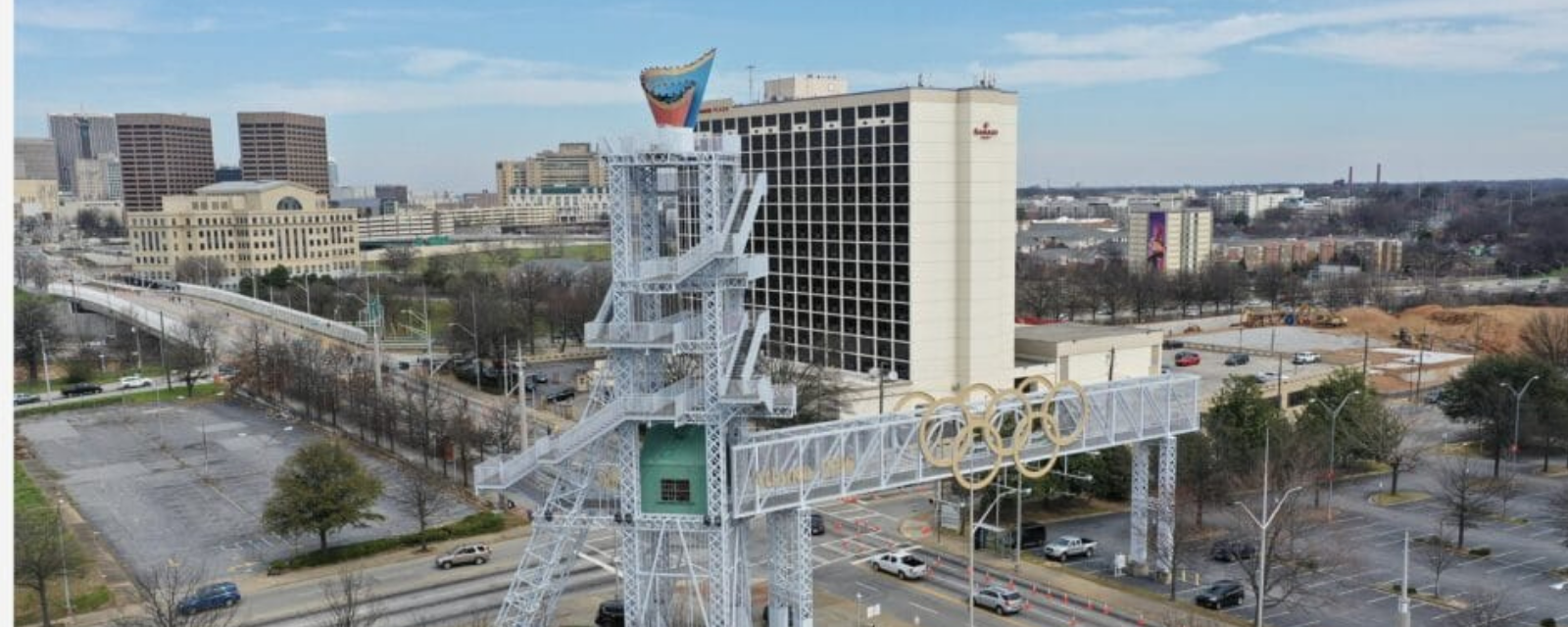
Nearly 1,000 signatures in, and Summerhill is making it very clear: the Olympic Cauldron is not going anywhere without a fight.
A grassroots petition is pushing back hard against Georgia State University’s plan to relocate the top section of the 120-foot tower and bridge structure that has loomed over Hank Aaron Drive since 1996. You know the one. The cauldron Muhammad Ali lit on July 19, 1996, in the moment that still makes Atlantans get a little misty when it pops up on the timeline. GSU announced it wants to move that piece to Centennial Olympic Park, working alongside Billy Payne, the chairman of Atlanta '96 Legacy and the man who led the bid to bring the Games to Atlanta, and former Mayor Andrew Young. Summerhill said: absolutely not.
The “Save Our Torch” campaign is calling the 1996 relic an “essential part of our community,” and the petition is asking that all relocation efforts be suspended until stakeholders sit down with residents and actually talk. According to the reporting from Urbanize Atlanta, the campaign argues Summerhill has already given enough through years of stadium-adjacent displacement. The petition puts it plainly: “Summerhill has given enough. We will not give up our history quietly.” Losing the cauldron would mean losing one of the last visible threads tying the neighborhood to the global moment it hosted.
Why this fight feels different
Here is where I want to pump the brakes for anyone thinking “it’s just a sculpture.” It is not just a sculpture. Summerhill was the first neighborhood in Atlanta established by freed people after emancipation, founded in 1865. The cauldron sits over Hank Aaron Drive in a neighborhood that absorbed Olympic Stadium, then Turner Field, then the Georgia State conversion, then the wave of redevelopment that followed each one. Every single time the neighborhood was told something was being built for them, the footprint changed and the people inside it changed too. So when residents say moving the torch is one displacement too many, they are not being dramatic. They are reading the pattern.
And the question protesters keep asking is a fair one: why does refurbishment require relocation? Nobody from GSU has answered that in a way the neighborhood finds satisfying. WSB-TV captured residents standing under the structure last week saying exactly that: fix it where it stands.
Where did Muhammad Ali light the Olympic cauldron?
For anyone who doesn’t know the history: right here. Atlanta. The 1996 Centennial Olympic Games. Ali, hands trembling from Parkinson’s, holding the torch up at the opening ceremony on July 19, 1996. The flame traveled up to the cauldron that still stands at the edge of Summerhill. That is the structure GSU wants to strip of its cauldron. The tower and the Olympic rings bridge stay, per GSU’s plan. But the bowl Ali’s flame first touched goes to Centennial Olympic Park. That is what the petition is fighting to prevent.
What the city has said so far
Atlanta City Council unanimously passed a resolution asking for the cauldron to stay put and for stakeholders to bring community members to the table. That is a meaningful signal, even if resolutions do not carry the force of a vote against GSU’s plan. Multiple sources have framed this as a state-level decision, not a local one, meaning the council’s resolution is pressure, not a veto. The combination of the council resolution, the petition pushing toward 1,000 signatures, and a rally on the ground is the kind of three-front pressure that tends to make institutions blink.
If you want to see how neighborhoods around Atlanta keep getting pulled into these tug-of-wars between institutions and residents, the pattern shows up everywhere from the Civic Center redevelopment to what is unfolding with South Downtown’s Terminal District. Different blocks, same conversation about who gets to decide what stays.
The neighborhood itself is worth showing up for
If you have not spent real time in Summerhill lately, the cauldron is one stop on a walk that should also include breakfast at Grits and Eggs Breakfast Kitchen and a drop-in at JD's Summerhill Variety Deli. The neighborhood is not a museum piece. It is a living block, and the people pushing the petition live, eat, and raise kids inside it.
Move the cauldron and you do not just move a sculpture. You separate the only physical artifact from that moment, the actual bowl Ali’s flame first touched, from the place where it happened. The tower stays. The bridge stays. But the thing people drove past for 30 years and understood as “this is where Atlanta hosted the world” goes somewhere else, somewhere with more foot traffic and more tourists, because a small group of private interests decided Summerhill wasn’t visible enough to carry its own legacy. That is what State Rep. Phil Olaleye said on the House floor, and he was right. GSU should refurbish it in place. The neighborhood has earned that.


