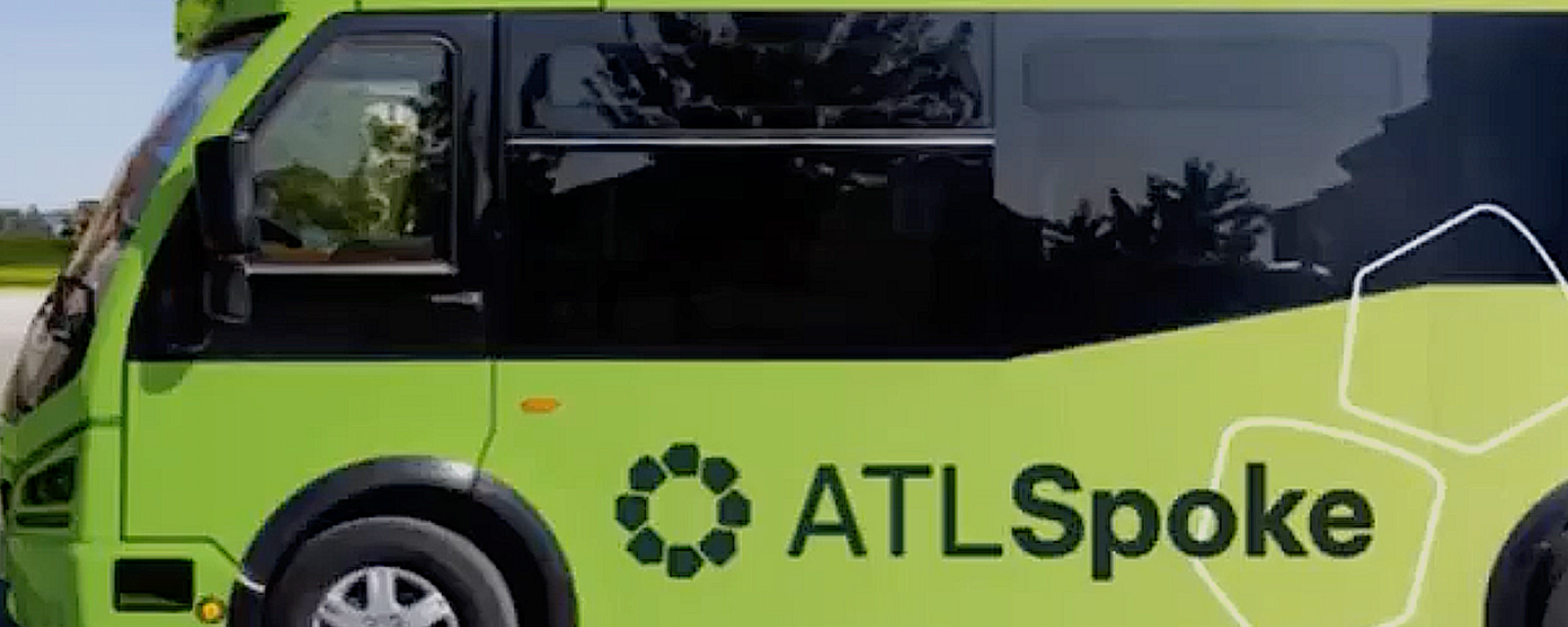
Atlanta's Southwest corridor just got a transit option that didn't exist last week. The BeltLine's ATL Spoke pilot went live June 5, and for the next year, the ride costs nothing.
The shuttle is electric, autonomous, and runs approximately two miles on public streets. Four vehicles in the fleet, each holding up to 12 passengers. Service runs daily noon to 10:00 p.m., and on World Cup match days that window opens up to 8:00 a.m. and runs through midnight. Every 12 to 15 minutes, a shuttle comes.
Where it actually goes
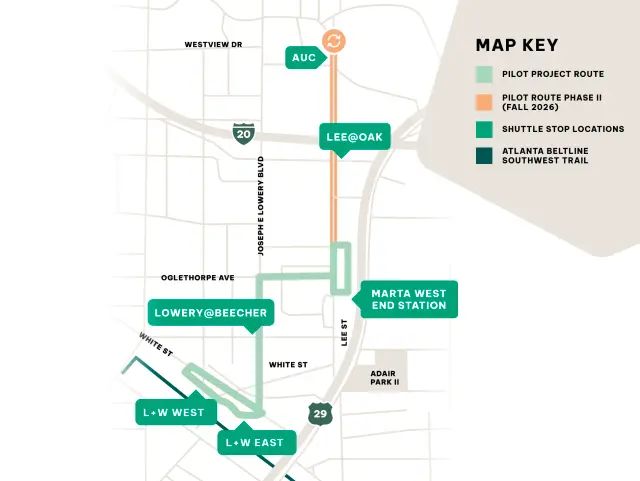
The route connects the BeltLine Southwest Trail to MARTA rail with four stops: West End MARTA Station, Joseph E. Lowery Blvd at Beecher Street, and two points inside Lee+White, one outside the Food Hall at the west rideshare spot, and one outside Boxcar and Wild Heaven at the east rideshare spot. Phase 2 extends the route north to the Atlanta University Center, timed for the fall semester.
The BeltLine is calling it a last-mile solution, which is the right way to describe it. Getting off the train at West End has never been the problem. Getting from that platform to the places you actually want to reach along the Southwest Trail has always been the friction point.
Wait, autonomous? Who's driving?
The vehicles are Karsan Autonomous e-JESTs, operated through Beep's control centers using Adastec software. Autonomous doesn't mean unattended. Every shuttle runs with a trained onboard attendant who can field questions and step in manually if anything unexpected comes up. That detail matters for anyone picturing a robot bus with no human fallback.
Why this stretch, why now?
West End has been building real density of place for years without the transit infrastructure to match. Portrait Coffee anchored itself on Ralph David Abernathy and became a national story. Tassili's Raw Reality has been a neighborhood institution long before the corridor got any attention. Wadada Healthy Market filled a grocery gap the rest of Atlanta is still talking about. Lee+White turned a former industrial strip into a food and brewery destination. These aren't new arrivals. The transit connection is what's new.
For World Cup, the extended hours are a direct signal. Atlanta is a host city, and international visitors moving through West End MARTA are exactly the audience that will form an opinion about Atlanta based on what happens between the train platform and the neighborhood. A free autonomous shuttle running on a consistent schedule is a concrete answer to that problem.
The pilot also connects to a bigger conversation we've been following in MARTA 2026 roadmap. After the Eastside BeltLine rail halt, a lot of riders are watching to see what kind of transit investment actually moves forward in this city. ATL Spoke is a smaller bet, but it's a real one.
What happens after 12 months?
The pilot lives or dies on ridership data. If locals fold ATL Spoke into their actual routines, and if the BeltLine keeps that data visible and public, the case for expanding the model gets much stronger. If it runs mostly empty, it stays a good-looking press moment and nothing else. The infrastructure is already rolling. What happens next depends on whether the neighborhood uses it.
This is the kind of small, specific infrastructure win that actually moves the needle. We can argue all day about citywide transit policy, but a free 12-passenger shuttle connecting a MARTA station to a BeltLine corridor every 12 to 15 minutes is something a West End resident can use tomorrow. Pair it with the businesses already humming along that stretch and you have a real proof of concept, not a press release. If the BeltLine keeps the data public and the ridership shows up, this becomes the template for every other MARTA station in Atlanta.


