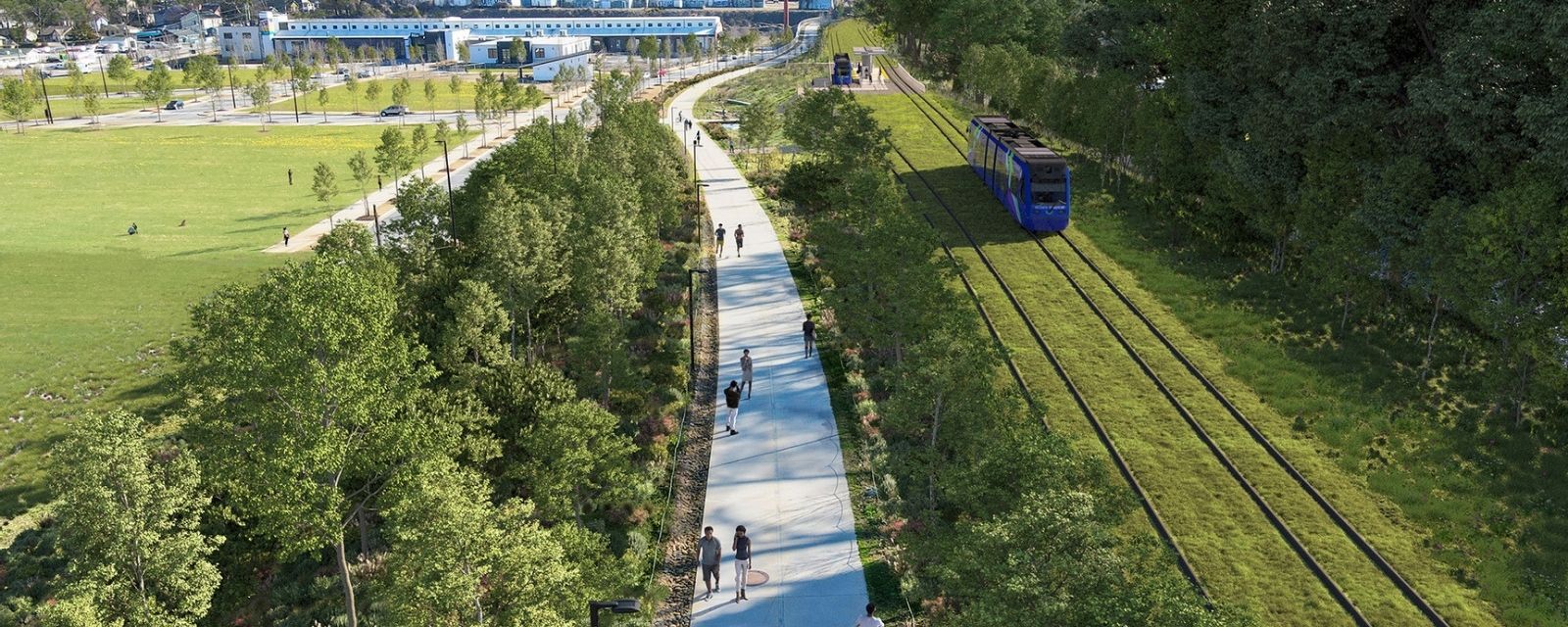
When the Southside Trail opened in June, we asked what happened to the transit that was supposed to run beside it.
Atlanta Beltline Inc. now has its most complete answer yet: a proposed $3.5 billion light-rail system with recommended routes, stations and projected ridership.
What it still does not have is complete funding or a construction date.
What the study delivered
On Sept. 3, Atlanta Beltline presented the final recommendations from its three and a half year transit study.
The proposal has three bidirectional routes: one around the full Beltline and two smaller routes connecting the northern and southern portions with Downtown. Each would run every 20 minutes, producing approximately 10-minute service where routes overlap.
The $3.5 billion estimate is stated in 2025 dollars and based on work that is only 10 to 20 percent designed. It includes $270 million for 42 vehicles and $210 million for support facilities.
It does not include estimated costs for four proposed MARTA stations at Armour Yard, Krog Street, Murphy Crossing and Joseph E. Boone Boulevard.
The system is projected to carry 4.2 million annual unlinked trips, meaning each boarding is counted separately. About 21 percent are expected to be new transit trips diverted from cars.
Those numbers give Atlanta something more concrete than a rendering. They do not make the system ready to build.
Where the trains could stop
Thirteen stations are recommended across the southwest and southeast Beltline, stretching from Donald Lee Hollowell Parkway through West End, Pittsburgh Yards and Boulevard to Glenwood Avenue. Another possible station between Boulevard and Glenwood remains under consideration.
On the northwest side, the Beltline recommends using the CSX freight corridor between the Bankhead area and Lindbergh. The agency says that route would provide the fastest trip, lowest construction cost, highest projected ridership and direct service to Piedmont Hospital.
Atlanta does not control that railroad property.
Beltline principal engineer Shaun Green described the negotiating problem plainly: “CSX has no reason to take our phone call.”
That makes the route a recommendation, not an agreement.
The station map will still influence development conversations. But anyone buying, leasing or building near a proposed platform should treat it as planning information not a promise that a train will arrive on a particular date.
The funding gap is measured in billions
Atlanta voters approved the More MARTA half-penny sales tax in 2016. The program adopted in 2018 assigned approximately $570 million to Beltline light rail and related investment.
That was never enough to build a complete loop. It covered selected segments and assumed Atlanta would attract additional money.
The new $3.5 billion estimate makes the size of that gap clearer.
It also arrives after Streetcar East, the most advanced Beltline rail project, reached approximately 30 percent design and was paused. MARTA still lists the extension as a More MARTA priority, but its work and spending have no restart date.
The lesson is simple: even substantial design work does not guarantee construction.
City Council wants an implementation plan
On Sept. 8, Council member Kelsea Bond introduced a resolution asking the mayor’s office, MARTA, Atlanta Beltline and other city departments to produce a funding and implementation plan by Jan. 26, 2027. Eight other council members signed onto it.
As of Sept. 10, the resolution has not been adopted. Committee hearings are expected Sept. 15 and Sept. 16.
Passing it would not fund construction. It would require the agencies to identify how the proposal could move forward and in what order.
Residents can also comment on the transit study through Nov. 3. Atlanta Beltline expects to begin public engagement later this fall around the proposed Murphy Crossing MARTA station.
What riders have today
The Beltline-linked transit operating in West End today is ATL Spoke, a free autonomous-shuttle pilot.
It launched June 5 between West End MARTA and Lee + White and expanded to the Atlanta University Center on Aug. 19. Its four vehicles hold up to 12 passengers and arrive approximately every 12 to 15 minutes with trained attendants aboard.
ATL Spoke is a first and last-mile experiment, not a replacement for light rail. But it is the part of this transit conversation people can currently board.
Atlanta can no longer say it does not know where Beltline rail should go or what it could cost. The remaining question is political: will city leaders choose a first segment, fund it and put it on a construction calendar?


