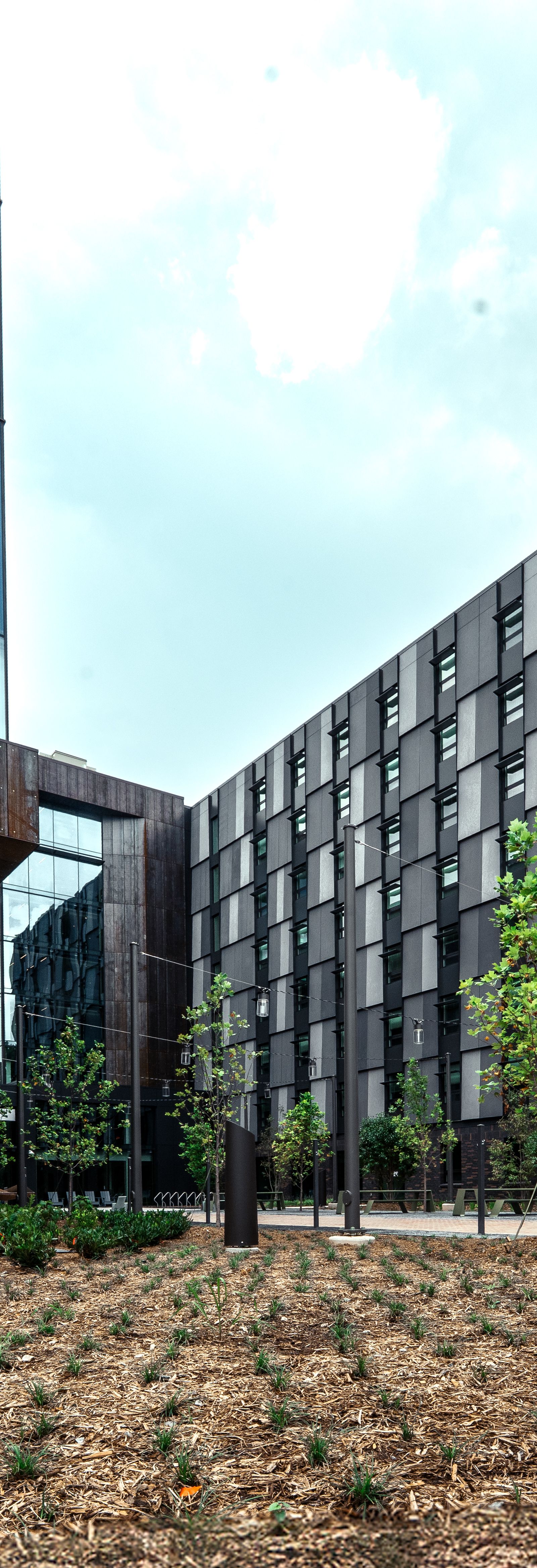
Peterson Hall supports enrollment growth, but it was also designed to house students displaced while older residence halls are renovated.
Every landlord within walking distance of Georgia Tech has done some version of this math: the school builds a dorm, the dorm holds X students, and X students stop renting apartments.
That math does not work cleanly on this building.
What opened on Curran Street
The Bud and Val Peterson Residence Hall opened at 920 Curran St. for the fall semester.
The eight-story, 191,000-square-foot building holds approximately 860 first-year students in traditional two-person rooms with shared bathrooms. The toilet and shower stalls have floor-to-ceiling privacy, a small detail that anyone who has lived in an older traditional dorm will recognize as not small.
The building includes study areas, wellness and fitness space, an esports lounge and Georgia Tech’s first 24-hour cashierless market.
It replaced a parking lot and landscape yard along Northside Drive between Eighth and Ninth streets. Construction began in 2024, a formal groundbreaking followed on March 5, 2025, and students began moving in on Aug. 15, 2026.
The hall is named for Bud Peterson, Georgia Tech’s 11th president, and former first lady Val Peterson. Bud Peterson remains president emeritus and a Regents’ Professor at the university.
Its opening brings Georgia Tech’s housing capacity to more than 9,600 beds across nearly 50 residence halls.
Why 860 beds is not 860 fewer renters
The University System of Georgia Board of Regents authorized the project in February 2023 to perform two jobs.
The first was accommodating Georgia Tech’s expected first-year enrollment growth over the following decade.
The second was providing housing for students displaced while older residence halls undergo planned renovations.
That second purpose makes Peterson Hall swing space as well as new capacity.
In February 2024, the Regents approved a $74.5 million renovation of Smith and Howell halls, which together contain roughly 418 beds.
The available records do not establish that all 418 beds will become unavailable simultaneously. But when rooms are taken offline for construction, part of Peterson Hall’s capacity will absorb students who already had campus housing rather than drawing renters out of nearby apartments.
The number to watch is therefore not the one announced at the ribbon-cutting. It is Georgia Tech’s net available housing after older rooms close for renovation, combined with how much the first-year class continues to grow.
Private developers are still betting on demand
The private student-housing market is not waiting for that answer.
Core Spaces and Capstone Communities are pursuing the redevelopment of the site currently occupied by The Cheetah near campus. The first phase calls for approximately 1,600 beds and more than 5,000 square feet of retail, with completion targeted for 2029.
ATL Vibes and Views previously reported on that proposal, which remains a plan rather than a completed project.
Core Spaces has already delivered Hub Atlanta nearby with 792 beds. Combined with the Peterson opening, those investments show how much demand both the university and private developers expect around Georgia Tech.
But they are serving different pieces of that demand. Peterson is reserved for first-year students and students displaced by renovations. Private buildings compete for upper-level students and others who either cannot or do not want to live on campus.
The “60 years” line does not hold up cleanly
Georgia Tech’s housing office describes Peterson Hall as the first new traditional-style residence hall built on campus in more than 60 years. Its opening announcement calls it the first traditional residence hall constructed since 1969.
Tech’s own records complicate both versions.
The university’s current housing page for Montag Hall identifies it as a traditional residence hall, says it was built in 1972 and lists 114 beds for students in the Freshman Experience program.
The discrepancy may come from a narrower internal definition of what qualifies as a newly constructed traditional hall, but Tech’s public pages do not explain that distinction.
The cleaner claim is also significant: Peterson is Georgia Tech’s first entirely new residence hall since 10th and Home opened in 2005.
The bed count has varied slightly too. Early planning documents listed approximately 850 beds. The current housing page says 860, while the opening announcement says approximately 862. “About 860” is the most defensible number.
Peterson Hall is real housing supply, and adding it matters. But landlords and renters should not treat every bed inside it as one apartment tenant removed from the market. The more useful signals will come after the ribbon-cutting: how many older beds Georgia Tech takes offline, whether total available campus capacity continues rising and whether nearby private buildings begin offering deeper concessions or leasing more slowly. If Peterson mostly absorbs enrollment growth and renovation displacement, its effect on nearby rents may be modest. If Georgia Tech keeps adding beds after the older halls return, that is when the off-campus market begins facing a different calculation.


