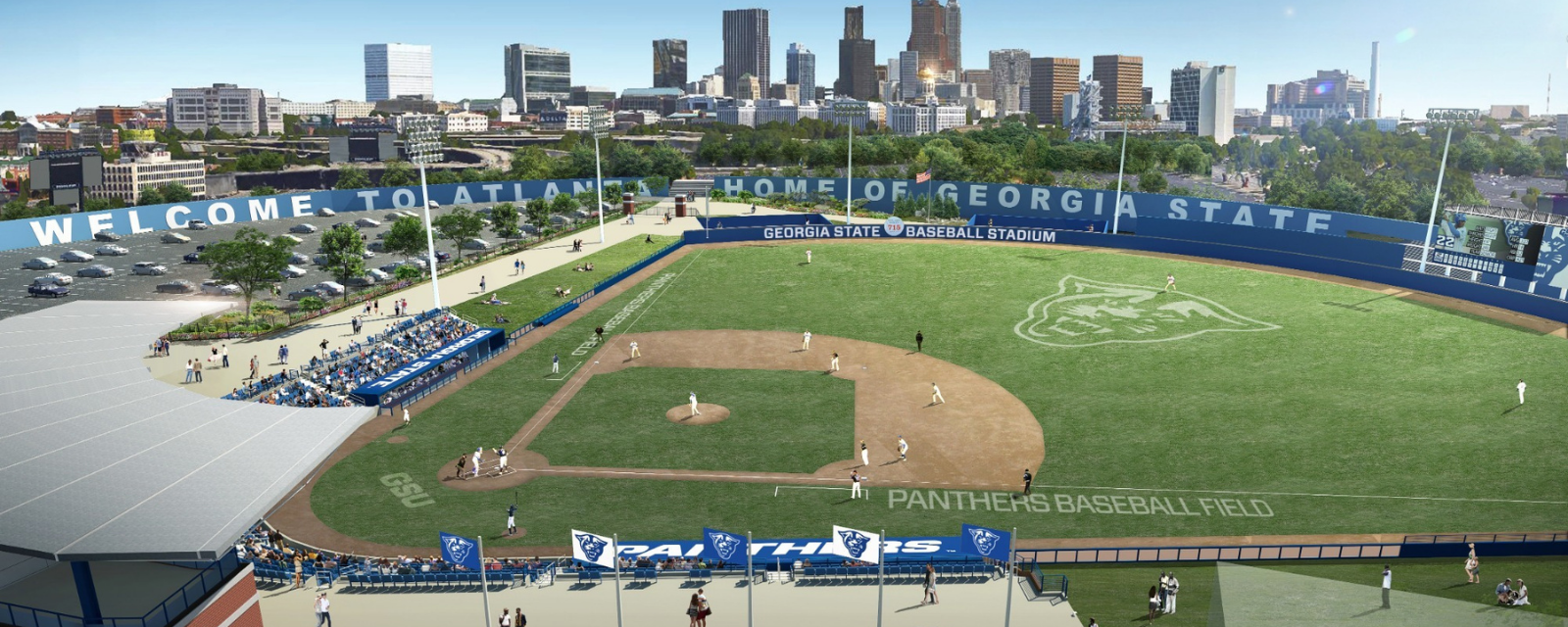
Georgia State’s new baseball stadium will preserve the location of Hank Aaron’s 715th home run. Nearby residents are fighting to keep another piece of history from leaving Summerhill.
A block wall and a run of chain-link fence stand in a parking lot, marking where Hank Aaron’s 715th home run landed on April 8, 1974.
They are not remnants of the original stadium. They were installed after Atlanta-Fulton County Stadium was demolished to preserve the location of the historic home run.
Now they are coming out.
In their place, Georgia State University plans a commemorative marker in left field of its new baseball stadium. The Hank Aaron statue currently outside Center Parc Stadium will move to the new ballpark’s main entrance.
One point needs to be clear: Georgia State is not building a baseball stadium beside another active baseball stadium.
Center Parc Stadium looks like a baseball venue because it used to be Turner Field, where the Braves played through 2016. Georgia State converted it into a football stadium after acquiring the property. The new ballpark is being built next door on the footprint of the earlier Atlanta-Fulton County Stadium and will bring GSU baseball closer to its downtown campus after years of playing in Panthersville.
What is going up on that ground
Officially named Chastain Childers Field at Bill and Susan Reeves Stadium, the new venue will sit between the GSU Convocation Center and Center Parc Stadium.
Plans call for 1,000 seats under a shade structure, artificial turf, field lighting and roughly 3,000 square feet of space for concessions, restrooms and a press box. Georgia State currently lists the project budget at $15.85 million.
The Board of Regents approved the project in May 2024. Atlanta approved its land-disturbance permit on Nov. 18, 2025, and construction began moving onto the site soon afterward. Georgia State expects the stadium to open in fall 2026, ahead of the 2027 baseball season.
For people living nearby, the practical question is parking. The complex takes over about 400 spaces in Center Parc Stadium’s Green Lot. GSU officials have said the nearly 900-space deck built beside the Convocation Center was intended to replace that capacity.
The numbers work on paper. The real test comes when baseball and football schedules overlap and drivers begin looking for spaces on neighborhood streets.
For businesses along Hank Aaron Drive and Georgia Avenue, including Grits and Eggs Breakfast Kitchen and Southern National, the stadium also adds another set of home games to the calendar. A 1,000-seat college ballpark is not Turner Field, but it can still change the flow of customers before and after games.
GSU’s baseball team currently plays about 12 miles east of the downtown campus in Panthersville. University officials have cited that field’s flooding problems, portable seating and limited facilities in making the case for the move.
Georgia State is using the same preservation method downtown
The ballpark is part of a broader pattern in how Georgia State is rebuilding its campuses.
Its $107 million College Town Downtown program includes nine initiatives, supported largely by an $80 million Woodruff Foundation grant.
Sparks Hall has been demolished, and Gilmer Street has closed to cars where the building stood. The Campus Greenway will extend into Hurt Park to create the Panther Quad. Marble panels from Sparks Hall are being reused in a commemorative column.
At 148 Edgewood Avenue, plans call for demolishing a 1926 Georgia Power substation to create a Fraternity and Sorority Life Plaza. The design includes salvaged brick and a mural acknowledging the building’s history.
In each case, Georgia State is preserving a fragment, marking what stood there and building something new around it.
The new Summerhill ballpark follows that same method. The wall and fence disappear, but the location of Aaron’s home run stays marked, baseball returns to the site and the statue moves closer to the history it represents.
The cauldron decision is different
That is why the fight over Atlanta’s Olympic cauldron reads differently.
In June 2026, Georgia State announced that the cauldron bowl would move to Centennial Olympic Park in collaboration with Billy Payne, former head of the Atlanta Committee for the Olympic Games, and former Mayor Andrew Young.
The 120-foot tower and Olympic rings bridge would remain in Summerhill. Only the bowl would leave. No relocation date has been announced.
Residents gathered roughly 2,000 petition signatures and held rallies opposing the plan. Atlanta City Council unanimously approved a resolution urging that the cauldron remain and asking decision-makers to include the community.
Summerhill representatives met with officials on July 23. Organized Neighbors of Summerhill President John Helton later said the officials gave no indication that they intended to reconsider the move.
Mayor Andre Dickens joined the opposition in August, writing that the cauldron “should remain in the neighborhood it has called home” for 30 years. He also criticized the process for failing to reflect the collaboration Summerhill, Peoplestown and Mechanicsville deserved.
The Georgia World Congress Center Authority has sought proposals for relocating the bowl to Centennial Olympic Park. The public record reviewed for this story does not establish that ownership of the structure has formally transferred from Georgia State or the University System of Georgia to the authority.
Preservation is not only about whether an object survives. Place gives the object part of its meaning. The new ballpark removes a modest marker, but keeps Hank Aaron’s historic location and returns baseball to the ground where the home run landed.Moving the Olympic cauldron would separate the bowl from the tower, bridge and neighborhood that have carried its story for 30 years.That difference is why these two decisions do not feel the same in Summerhill.


