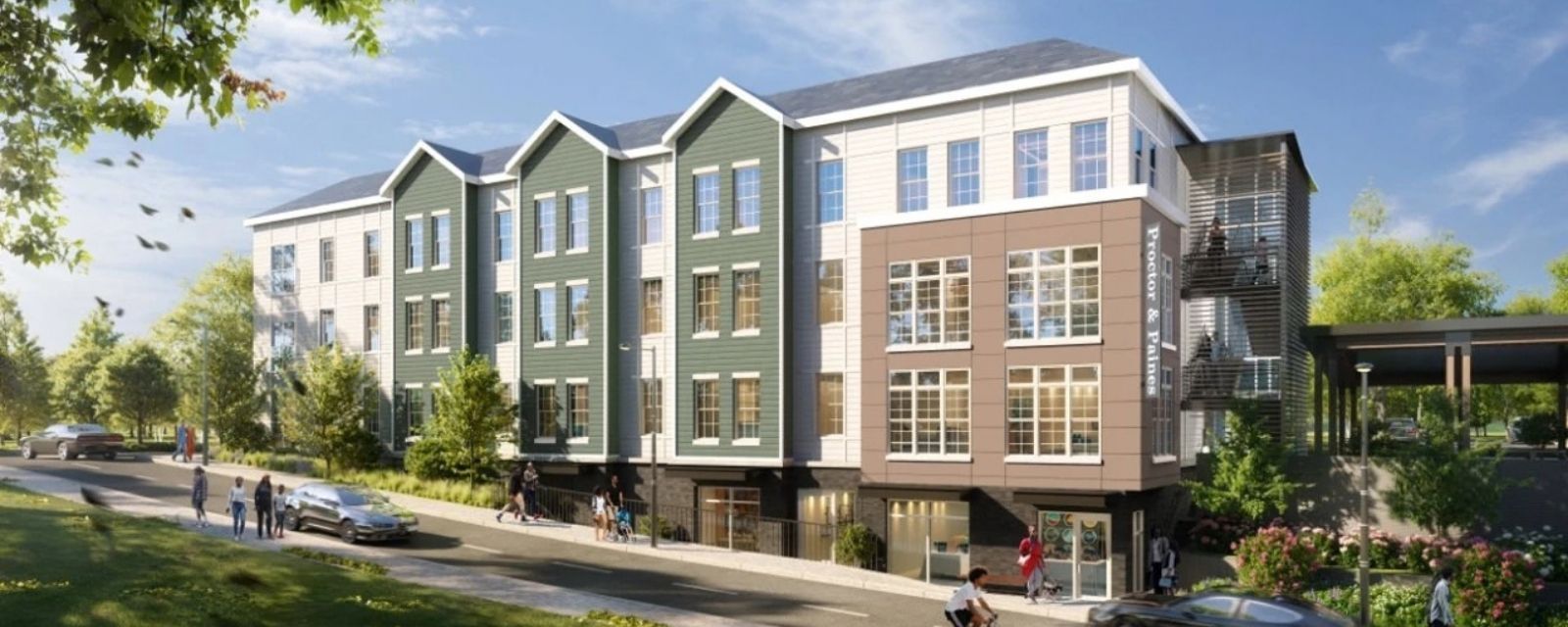
Up the hill from Kathryn Johnston Memorial Park, at the corner of Proctor Street and Paines Avenue, the former New Jerusalem Baptist Church is boarded up. The congregation moved on. The building stayed.
New Jerusalem Baptist came to 383 Paines Avenue in 1956. After fires in 1975 and 1980, members rebuilt the church both times. Its work in English Avenue extended beyond worship: the church's own history describes a community resource center and an employment program for Westside residents.
The congregation began services at a larger property on Dill Avenue in southwest Atlanta in July 2023. It did not cease to exist when the Paines Avenue building closed. After a fire at its southwest Atlanta property in 2024, the church bought its current home in Mableton in 2025.
Now the old Paines Avenue site is part of a housing plan. We first reported on this property in our coverage of Invest Atlanta's August funding vote. This is a closer look at what is planned for the church site, and what is still missing for people who might want to live there.
What is planned for the corner
Westside Future Fund calls the project Proctor + Paines. Its June project update describes 25 multifamily units and 10 single-family homes at the former church site and adjacent land in English Avenue.
According to Invest Atlanta, all 25 apartments will be reserved for households earning between 30 and 80 percent of Area Median Income, or AMI. That commitment does not tell a prospective renter what a particular apartment will cost. It also does not establish affordability terms for the 10 houses.
Invest Atlanta says Westside Future Fund plans to revitalize the former church building, not simply clear the site. The description includes a communal pavilion, covered parking and terraced pedestrian access between Proctor Street and Paines Avenue. It does not yet explain exactly how the existing structure will be used.
No apartments are available to lease yet
Westside Future Fund's June 23 update placed Proctor + Paines in planning, permitting and pre-construction. The work was happening behind the scenes, not at an active construction site. A groundbreaking or move-in date has not been announced.
The published project descriptions also do not give the apartment rents, the number of units at each income level within the 30-to-80-percent range, or the length of the affordability commitment. Terms for the single-family homes have not been made public.
Those distinctions matter. A household eligible for an apartment at 30 percent of AMI may not be able to afford one priced for a household at 80 percent. The broad range is a starting point, not a rent schedule, and it does not by itself establish a preference for current English Avenue residents.
The next checkable milestones are issued permits, a construction start, published rents and income tiers, and a stated affordability period. Until then, this is a proposed project, not housing a household can apply for.
Why has Invest Atlanta kept investing here?
The stadium is part of the answer, but the investment strategy predates it.
The city's original Techwood Park tax allocation district began in 1992. In 1998 it expanded to include English Avenue and Vine City, according to an Invest Atlanta assessment. The district's goals paired downtown tourism and development with reducing poverty, vacant housing and other signs of disinvestment in the neighborhoods to the west. A tax allocation district uses growth in property-tax revenue within its boundaries to help pay for redevelopment. Invest Atlanta now administers the Westside TAD.
The stadium brought a more explicit promise. As Atlanta prepared for the new Falcons stadium in 2013, City Council required a community benefits plan for surrounding neighborhoods. Invest Atlanta committed $15 million from the Westside TAD to a Community Improvement Fund, while the Arthur M. Blank Family Foundation pledged a separate $15 million. The plan called for affordable housing, job training, environmental work and other neighborhood benefits. In announcing its first grants in 2014, Invest Atlanta directly tied them to its commitment that Vine City, English Avenue and Castleberry Hill share in the stadium project's benefits.
That history does not establish the stadium fund as the source of Proctor + Paines' grant. Invest Atlanta identifies its 2026 award as a $1.5 million Westside TAD Ascension Fund grant. The published approval does not say it comes from the 2013 Community Improvement Fund. Westside Future Fund also reports support from the Woodruff Foundation. These contributions are not the project's full development cost.
Invest Atlanta's current description of the Westside TAD says the focus on Vine City and English Avenue responds to decades of disinvestment and population decline. It names improved quality of life and more equitable redevelopment as goals. So the answer is not simply "the stadium" or "affordable housing." Downtown growth, a stadium-related promise and neighborhood equity all appear in the public record, at different points in the timeline. Whether this particular investment benefits people already living in English Avenue is still a question.
The stadium helped bring attention and a promise of investment to Vine City and English Avenue. But the need for housing and neighborhood investment was there long before the stadium arrived. That is why I do not think the number of homes planned is enough to call Proctor + Paines a win yet. I want to know what the apartments will cost, how many will be affordable to households at the lowest end of the promised income range, and how long those rents will stay restricted. I also want to know the terms for the 10 houses. Keeping the church building matters. So does making sure people with roots in English Avenue have a realistic chance to live in what comes next. The building has a history that cannot be replaced by a unit count. The plan would keep it in use and add housing nearby. Whether that housing works for people already living in English Avenue will become clearer when Westside Future Fund publishes the rents, income-level mix, home terms and affordability period.


