A restaurant closes in a Midtown student housing building. An endcap goes dark at a Johns Creek shopping center. Ordinarily, those spaces sit empty while the leasing sign becomes part of the scenery.
However in this case, both are now Yemeni coffeehouses. According to the Associated Press, Yemeni coffeehouses are vibrant, late-night community gathering spaces that blend centuries-old Yemeni coffee traditions with contemporary café culture.
Haraz Coffee House replaced Twisted Kitchen at 930 Spring St. It occupies roughly 2,000 square feet, plus a 600-square-foot patio, and stays open until 10 p.m. Sunday through Thursday and midnight on Friday and Saturday.
Arwa Yemeni Coffee opened inside the former Capital Tacos at Johns Creek Festival. The 2,145-square-foot shop follows a similar schedule.
Two former restaurants are now two coffeehouses designed for customers who may arrive after dinner and stay awhile.
What these shops add beyond coffee
Metro Atlanta has plenty of bars and morning coffee shops. It has fewer comfortable, alcohol-free places where people can meet, study or sit with friends at 10 p.m. on a Tuesday.
That is the gap these businesses are filling.
For Georgia Tech students and people living around Spring Street, Haraz turned a closed restaurant into an active room at night. In Johns Creek, Arwa brought customers back to a vacant endcap.
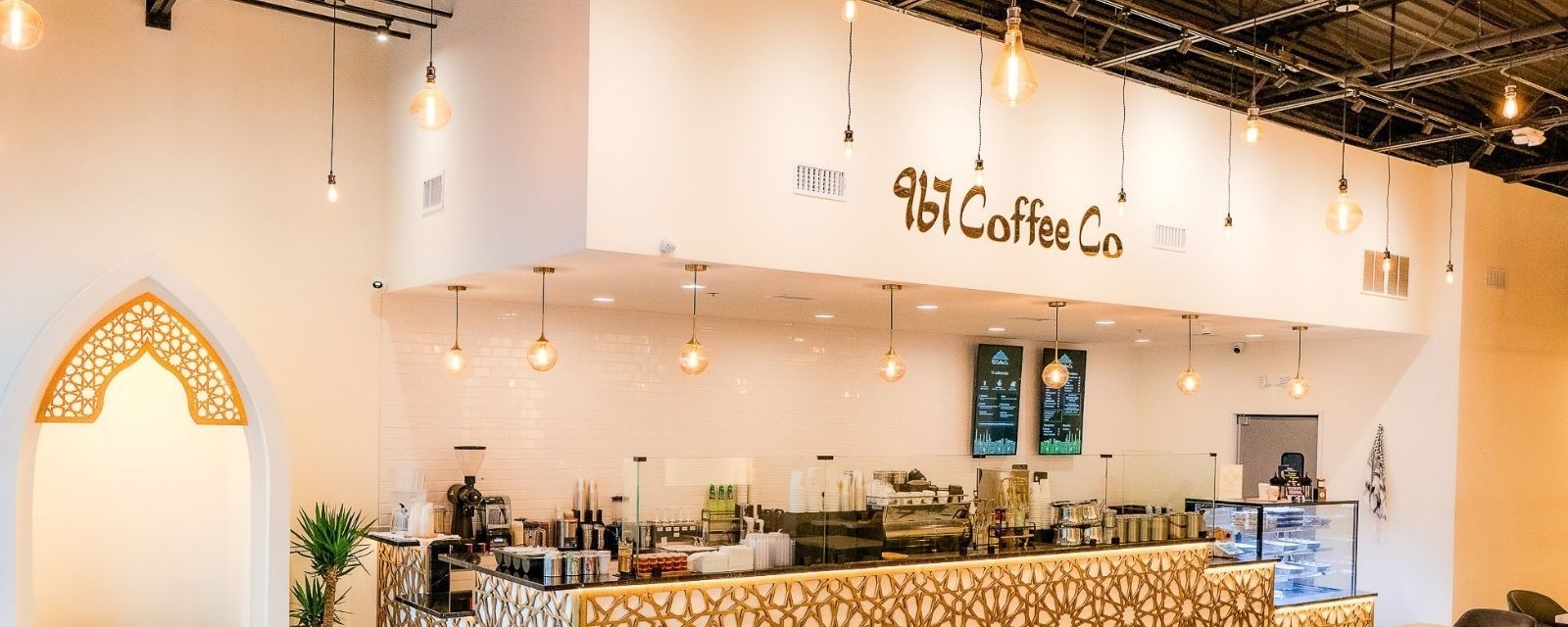
The clearest late-night example is 967 Coffee Co. in Roswell. It stays open until midnight Sunday through Thursday and 2 a.m. on Friday and Saturday. Its owners say the night shift is its busiest.
The operators say the space comes first
“We aren’t really catering to a morning, heading-to-work kind of crowd,” Qamaria cofounder Danish Dharani told Atlanta Magazine. “In my head, it’s a coffee shop second; it’s a space for people to enjoy first.”
That explains the real estate.
A business designed around long visits needs tables, seating and room for groups. Former sit-down restaurants often provide those features, along with restrooms, plumbing and food-service infrastructure.
These businesses are selling coffee, but they are also selling time inside the room.
Six shops across metro Atlanta
The category began taking shape locally in 2021, when Hesham Abdulla opened Mokhaport in Tucker.
Coffee plants are indigenous to Ethiopia, but Yemen became central to cultivating, brewing and trading coffee as a beverage. Beans passed through Yemen’s Port of Mokha for centuries, giving us the word “mocha.”
The metro Atlanta expansion accelerated in 2025 and 2026. Shibam Coffee opened in Alpharetta. Haraz arrived in Midtown. Qamaria Yemeni Coffee Co. opened in Duluth. Three cousins founded 967 Coffee Co. in Roswell. Arwa followed in Johns Creek.
That puts six Yemeni coffeehouses in six municipalities: Atlanta, Alpharetta, Johns Creek, Roswell, Duluth and Tucker.
Some are independent. Others are locally operated franchises. What connects them is Yemeni coffee traditions, shareable desserts, spaces designed for lingering and hours extending later than those of conventional cafes.
A cultural trend and a leasing strategy
The growth also makes sense for landlords.
Closed restaurants leave behind spaces that can be expensive to convert for unrelated businesses. Coffeehouses can reuse many of their features while serving customers from morning through late evening.
That can be especially valuable in suburban shopping centers where activity disappears after dinner. A late-night tenant changes when the parking lot is occupied, not just what one storefront sells.
The next question is how many locations the region can support. Alpharetta, Roswell, Johns Creek and Duluth are close enough that future shops could compete for the same customers. Six openings establish a category. They do not guarantee that every new location will work.
These operators identified two shortages at once: communities needed alcohol-free places to gather at night, and landlords needed tenants for restaurant spaces that had gone dark. The test is what happens outside each shop. If nearby businesses begin seeing more evening traffic, these coffeehouses are doing more than filling vacancies. They are changing when their commercial centers function. That is when a dining trend becomes a neighborhood pattern.


