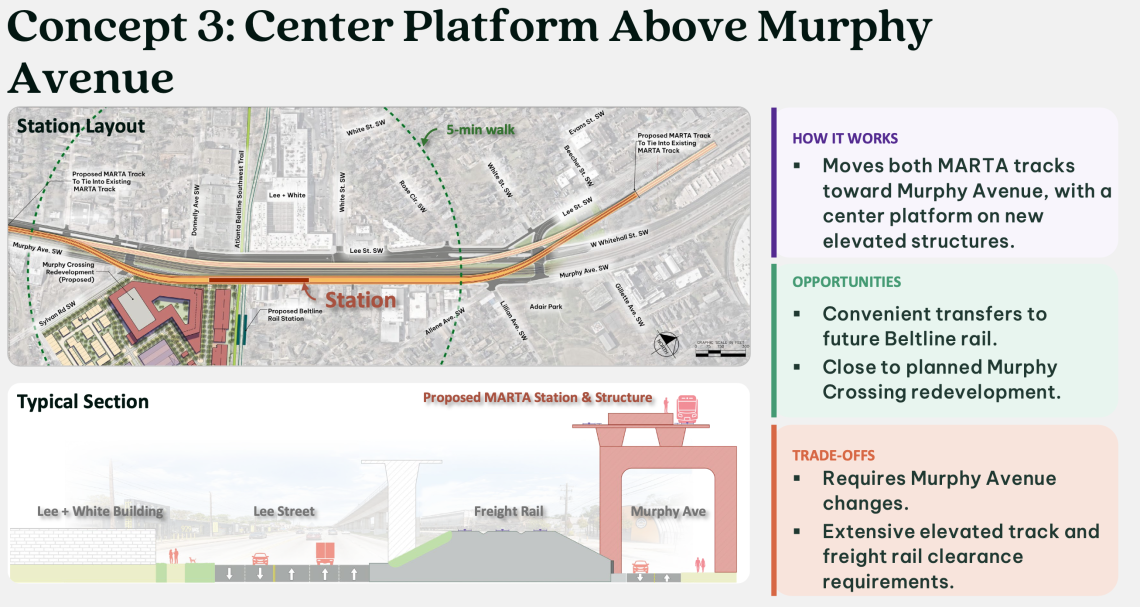
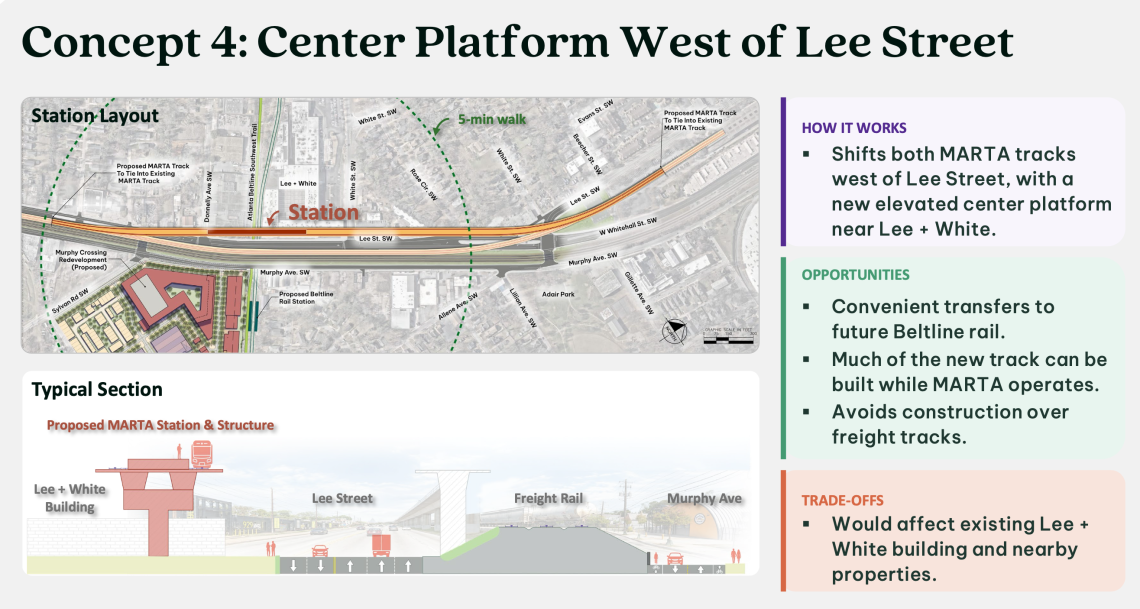
There are five drawings for a MARTA station at Murphy Crossing, the point where Oakland City, Adair Park and West End meet beside the Lee + White district. Seven alternatives were studied, two were judged unfeasible and dropped, and the remaining five are what the public is being asked about through Nov. 30 at beltline.konveio.com/murphy-crossing-infill-station.
This is a scoping study, not a groundbreaking. The station would sit between MARTA's existing Oakland City and West End stations, and Atlanta Beltline is running the preliminary work itself because, principal engineer Shaun Green told a public meeting, MARTA does not have the budget for it. The study is expected to run around $800,000 or $900,000, paid out of Tax Allocation District dollars. How a station gets paid for, and when anything might start, remain to be seen.
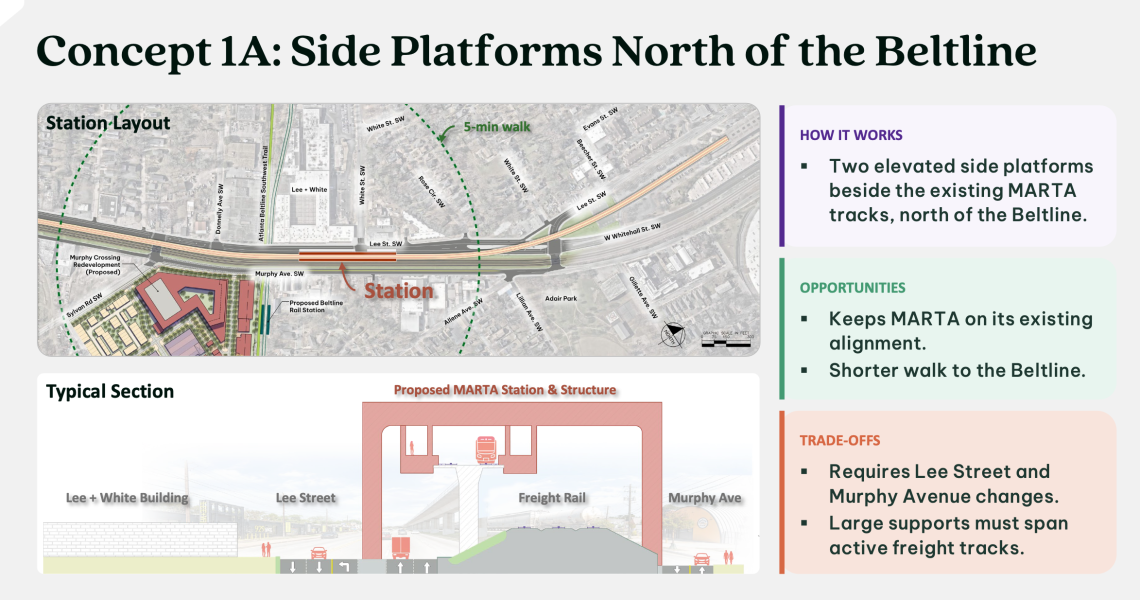
What separates the five options
The hard part here is vertical. There is roughly a 60-foot gap between where future Beltline transit would run and where MARTA's rail sits, and anything built in this corridor has to clear freight trains by at least 23.5 feet under CSX and Norfolk Southern rules. That geometry makes all five options complex, per Green.
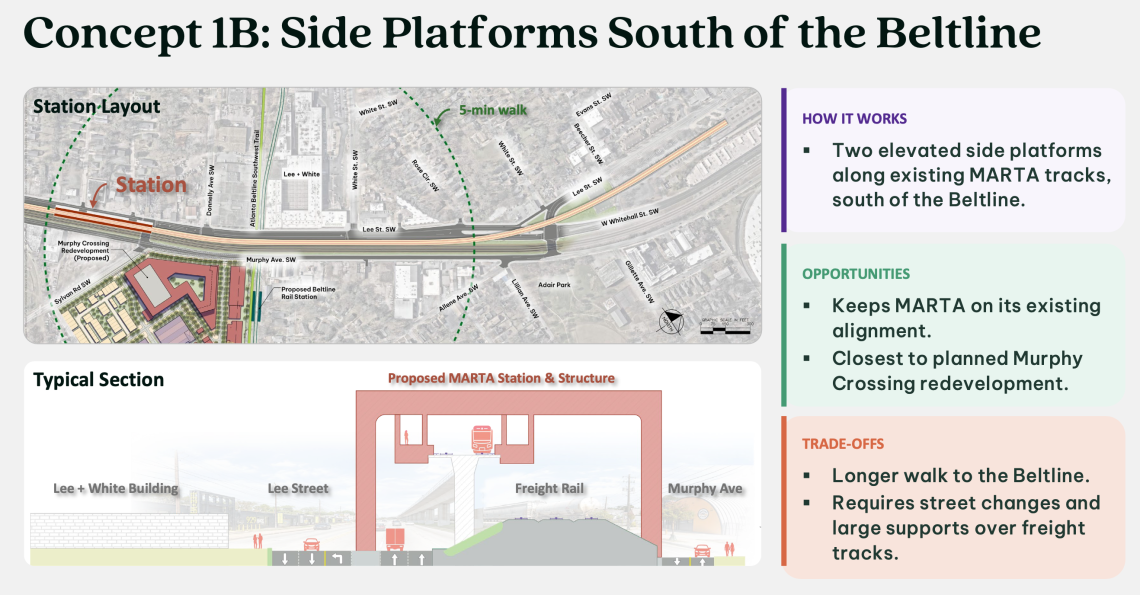
What actually differs between them: where the platforms land, how much current train service gets disrupted while crews build, and how far a rider coming off the trail below would have to walk. Those three variables are the whole decision, and they are exactly the kind of thing a person who lives on Murphy Avenue or Allene Avenue can speak to with more precision than an engineer can.
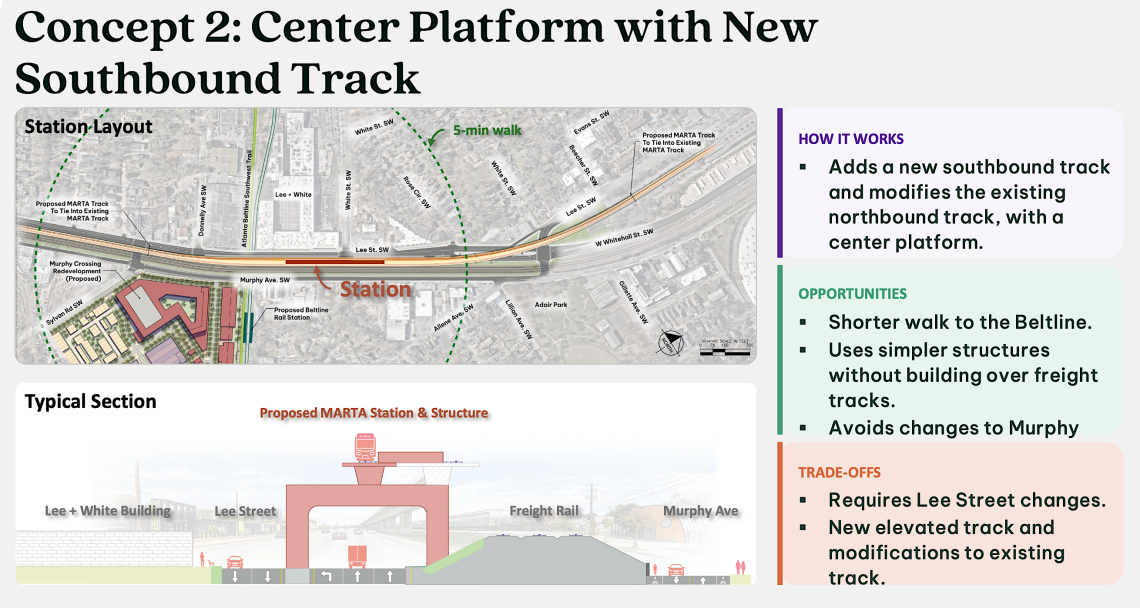
Green said citizen feedback gets combined with the Beltline's own qualitative analysis to determine which concept moves forward, with concepts and cost analyses finished and a locally preferred alternative chosen by next summer at the latest. That step lays groundwork for funding and construction.
Three different lines, three different clocks
It is easy to hear “Beltline” and “transit” and treat them as one project. They are actually three separate efforts, each moving on its own timeline. The first is the trail. About 16.7 of the 22 mainline miles are open, and the Beltline expects to close the full loop by 2030.
The second is light rail. In September 2026, the Beltline finished its transit study and recommended a three-route light rail system estimated at $3.5 billion at 2025 prices, before inflation, so the final cost will likely be higher. That figure is based on designs only 10 to 20 percent complete, and it does not include the four proposed MARTA infill stations at Armour Yards, Krog Street/Hulsey Yard, Murphy Crossing and Joseph E. Boone Boulevard. We covered that study in “The Beltline Finished Its Rail Plan. Nobody Can Say Who Pays for It.”
The third is the Murphy Crossing station itself. It is the next chapter after the rail study, and it is moving forward on its own track, with its own design options, its own scoping study and, eventually, its own funding.
The backdrop: Mayor Andre Dickens announced a Murphy Crossing station during his State of the City address in March 2024, then formally named all four infill station sites in an administrative order that April. Funding has been a long-running gap. The More MARTA program, whose project list MARTA approved in 2018, set aside about $570 million for Beltline rail, enough for roughly 61 percent of the planned route but not the full loop. Now, two and a half years after the announcement, Murphy Crossing has concept designs and a timeline for choosing one.
The part that moves first
The station is still on paper, but the land it would serve is already changing. Murphy Crossing, the 20-acre former state farmers market site the Beltline owns next to the proposed station, is moving ahead on its own schedule, separate from the rail plans.
Senior development manager Andrea Foard said civil engineering is complete, a contractor has been selected and state-level reviews are done. Demolition should begin before the end of 2026, with most of it finished in the first quarter of 2027. Permitting and the renovation of existing buildings into commercial and office space will follow. Design work on the first phase’s adaptive-reuse buildings and a 1.4-acre stormwater park connected to the trail is slated to move forward this quarter.
To be clear, this is redevelopment of the property, not construction of the station. Across five phases, the full buildout calls for 625 homes, about 82,000 square feet of commercial space, 70,000 square feet of retail and 103,000 square feet of light industrial space. The Beltline finished assembling the property at 1050 Murphy Avenue in 2018 and has since ended deals with two outside development teams, which is part of why the project has taken this long to take shape.
New housing is already arriving around it. Woodrow House, on a neighboring site along the trail, is now leasing, and 1121 Allene, a for-sale townhome community at the corner of Allene Avenue and Warner Street, is under construction steps from the Beltline
I think the most useful thing in this round is the comment period as it's important that the community has a chance to have their ideas and concerns recognized publicly before commitments are made. The five concepts differ on walking distance and service disruption, and those are lived questions, not technical ones. If you utilize the Oakland City or West End Stations, or you own something along Murphy or Allene, the Konveio site is open until Nov. 30 and it costs you nothing. What I will be watching after that: whether a preferred alternative actually lands by next summer, and whether the Beltline and MARTA can name a funding source once it does, because a chosen concept with no budget behind it is still a drawing.


