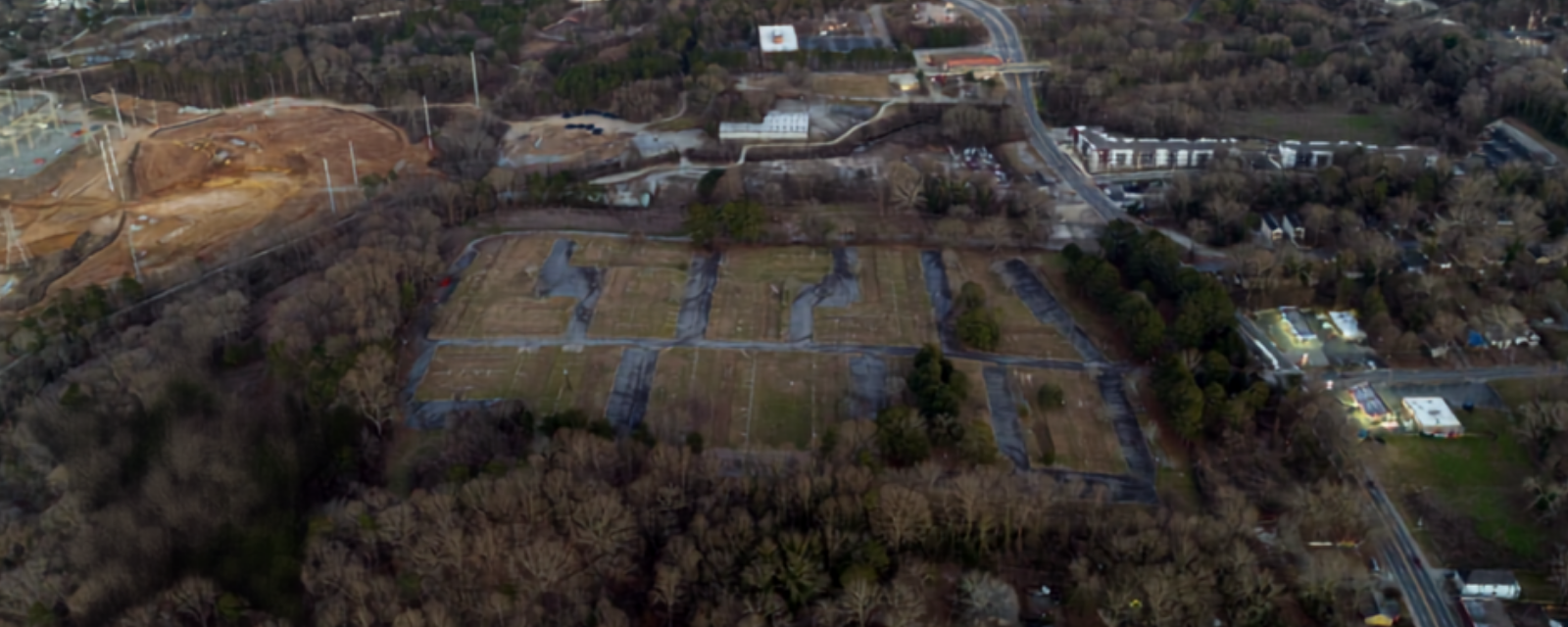
Twenty-two and a half acres of fenced, empty ground on Donald Lee Hollowell Parkway have been part of three major development announcements in eight years.
On Saturday, Sept. 12, the City of Atlanta and the Atlanta Urban Development Corporation will hold a community celebration on the property. The event runs from 10 a.m. to 2 p.m. at 1401 Donald Lee Hollowell Parkway, about a five-minute walk west of Bankhead MARTA station.
This time, the city has something tangible to celebrate: Microsoft donated the land.
What it does not have yet is a development plan.
What was promised, and what has been delivered
In 2021, Microsoft bought approximately 90 acres at Quarry Yards and pledged to reserve 25 percent of the property for affordable housing and other community needs.
The company described a future that could include housing, neighborhood services, education and workforce opportunities. Local leaders spoke publicly about jobs, a grocery store, a pharmacy, a bank and a walkable Main Street supporting small businesses.
Microsoft paused planning for its Atlanta campus in 2023. Those offices, jobs and amenities were never built.
The 22.5-acre donation fulfills the land portion of Microsoft’s community-use commitment. It does not deliver the community itself.
There are no approved buildings, committed retail spaces, selected businesses or construction contracts attached to the parcel yet. The remaining Microsoft property is also separate from the land now controlled by the city.
That distinction is the story. Grove Park has received valuable land, but everything residents were told might happen on it must now move through another development process.
What actually happens next
A procurement document.
In November 2025, AUD chief executive John Majors said the agency could reasonably issue a Request for Qualifications for a development partner in the fourth quarter of 2026, select that partner by the second quarter of 2027 and begin construction in 2028.
Those were projections, not binding deadlines.
The Sept. 12 event arrives near the beginning of that first window. The milestone worth watching is whether AUD issues the solicitation before the end of this year and what requirements it puts inside.
A Request for Qualifications will not select the shops or restaurants that eventually occupy the site. It will help identify a development partner with the experience and financial capacity to work with AUD and the community on a plan.
That means nothing physically changes on the property this month. For nearby residents, real estate agents and contractors, 2028 remains the earliest publicly discussed construction target.
The ground has to answer first
Environmental testing comes before a development plan can become reliable.
The property was previously enrolled in Georgia’s Brownfield Program, but no final corrective-action plan was completed. Microsoft provided AUD with environmental assessments already conducted on the site, and AUD said it would perform additional testing.
Majors said the agency could not yet determine how much of the property could be developed or what remediation would be required.
That uncertainty matters when residential numbers are repeated. Majors said 400 to 500 homes could be conceivable, depending on the final plan. Mixed-income housing, retail, commercial space and community facilities have all been described as possibilities.
“Conceivable” is not “approved.” No unit count, building arrangement or commercial program has been adopted.
AUD’s general development standard provides a floor rather than a site plan. The agency typically requires at least 20 percent of the homes it supports to be reserved at 50 percent of Area Median Income and another 10 percent at 80 percent AMI. Its minimum affordability period is 25 years, including a five-year step-down.
Whether this particular site goes further will be decided through planning, negotiation and procurement.
What the opportunity means for a local business
Right now, there is no storefront to lease and no project contract to bid on.
That does not mean local businesses should wait until construction starts to pay attention. The upcoming RFQ is when AUD can require the eventual development team to create access instead of merely promising it.
There are three potential lanes for small businesses.
The first is the development process itself. Environmental firms, architects, engineers, community-engagement consultants and other professional-service companies could join a larger development team responding to the RFQ.
The second is construction. Remediation, site preparation, utilities, concrete, landscaping, electrical work, plumbing, security and other packages could eventually become subcontracting opportunities.
The third is occupancy. If the final plan includes retail, local businesses could compete for storefronts but only if space is built at rents they can carry.
None of those opportunities is guaranteed yet.
The city has not announced a local business participation requirement, a neighborhood hiring target, an affordable commercial space set-aside or a first-look leasing program for Grove Park businesses. There is no published retail square footage, rent structure, tenant-improvement assistance or application process.
Those details should be requested before the development partner is selected, when the public still has leverage over the plan.
Three plans have promised this land a neighborhood
In February 2018, the original Quarry Yards development team unveiled a first phase with 850 residences, a 300-room hotel, restaurants, retail and more than 500,000 square feet of office space.
In 2021, Microsoft purchased approximately 90 acres and introduced a corporate campus vision, with 25 percent of the property reserved for affordable housing and other community uses.
In 2023, Microsoft paused that planning process. Its larger campus remains on hold.
In November 2025, the city announced that Microsoft would donate approximately 22.5 acres through AUD. The city now describes the donation as complete and the Sept. 12 gathering as a celebration of that transfer.
What Grove Park has today is public control of a significant piece of land. That is more concrete than another private rendering, but it is not the same as housing, a grocery store, a construction contract or a local business opening its doors.
The next promise will be written into the RFQ.
The dates that matter now
This parcel has been announced enough times that the calendar is more useful than the stage.
Watch whether AUD releases its development-partner solicitation by the end of 2026. Ask when environmental results will become public. Then watch whether a partner is selected by the second quarter of 2027 and whether the final agreement includes measurable opportunities for Grove Park businesses.
Those answers will tell us what was actually delivered and who gets to participate in it long before anyone breaks ground.
I have watched this parcel get announced enough times to stop grading announcements and start grading calendars, and this is the first promise where the promiser is the city itself, which means for once there is a public paper trail you can hold someone to. So hold it to the paper. Ask AUD whether the RFQ went out in the fourth quarter of 2026 and, if it slipped, by how long. Ask what the environmental testing found and when the results were published. Ask whether a partner was selected by the second quarter of 2027. Those three answers will tell you more about 2028 than any ribbon, any speech, and any rendering shown on a Saturday morning in September.


