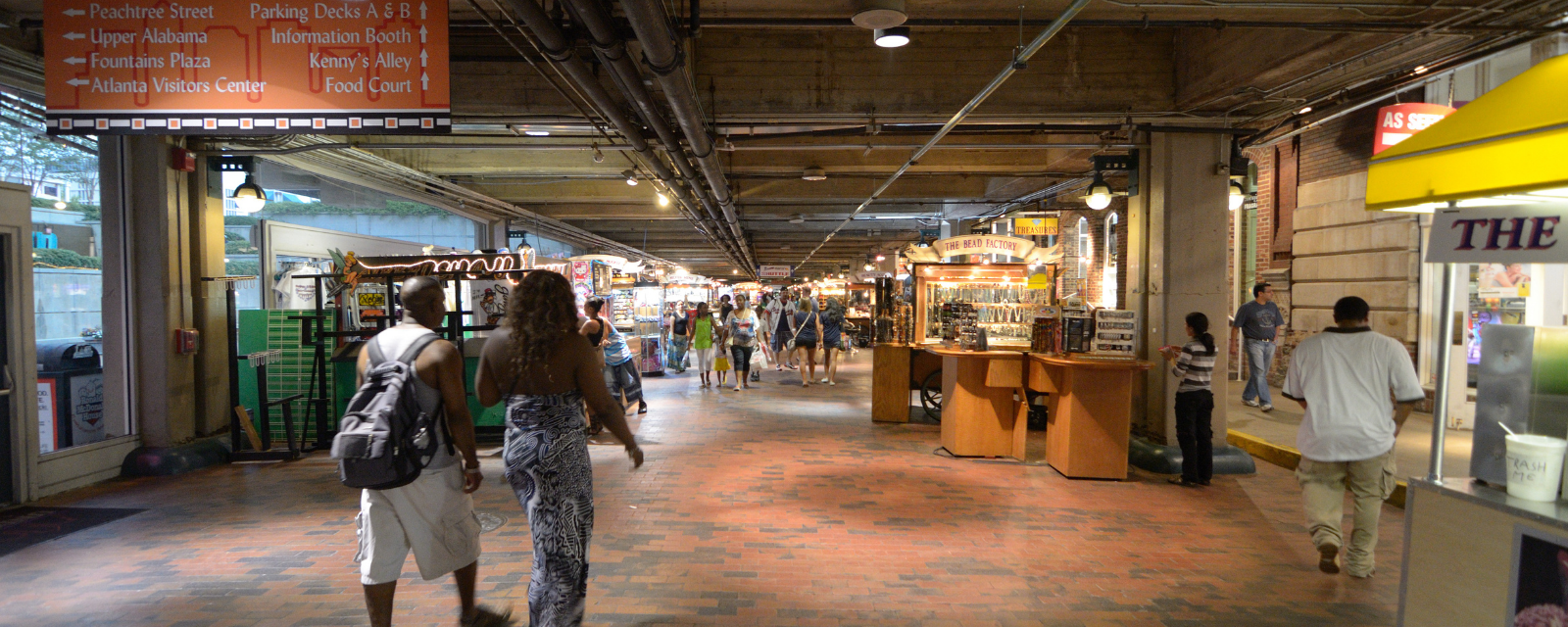
Underground Atlanta just came out of the World Cup buzzing, and owner Shaneel Lalani is not wasting the momentum. This week he laid out plans to push the district from around 65 percent leased to more than 90 percent, with a food hall, apartments, and a lineup of targeted tenants he wants in fast. The catch? He is openly saying the private side has done its part, and now public funding is the piece that has to show up.
If you have been tracking South Downtown at all, you know this is the story that has been quietly reshaping the whole southern edge of the core. Underground is not a side project down there. It is the anchor.
What is actually going in?
Lalani is targeting sports bars, local and international restaurants, tattoo studios, and other concepts to fill the district. Layered on top of that: a food hall and apartments carved out of existing space. The mix is the point. Underground has spent decades cycling through identities, and what Lalani is describing sounds less like a mall and more like a neighborhood, one that finally treats the space as somewhere people live, eat, and hang out, not just pass through.
And yes, I know the skepticism. We have all heard "Underground is back" pitches before. What is different this time is that the leasing math is already moving. Getting from 65 to 90 percent is not a hypothetical, it is a leasing sprint with specific tenant categories attached.
So why does he need public money?
Here is where it gets real. Lalani is not asking for help to survive. He is asking for help to compete. Downtown has a lot of chips on the table right now, other big projects chasing the same construction dollars, the same tenants, the same visibility. Without a public funding assist, the residential piece, the piece that turns Underground from a destination into an actual neighborhood, is the part that stalls.
That is the friction point residents should pay attention to. We keep saying we want a downtown that is alive at night. Alive at night requires people who live there. People who live there require apartments getting built. Apartments getting built, in this market, requires the gap financing to pencil out.
It is the same conversation happening across the city. Look at what is unfolding a few blocks over with the South Downtown Atlanta Redevelopment, or how affordability is being wrestled with in projects like The Wren at 640. All neighborhoods with the same underlying question: who pays to close the gap between what the market delivers and what a real neighborhood needs?
What does the World Cup have to do with any of it?
Everything, actually. The tournament dropped hundreds of thousands of visitors into the core, and Underground caught a lot of that foot traffic. Lalani is basically arguing that the World Cup proved the district works when it is programmed and full. The question now is whether the city keeps that energy going in a boring Tuesday in February, not just a Saturday in July.
If you want to feel the district for yourself before the next phase kicks in, keep an eye on the our Things to Do weekly social events post, where we not only share different events all over the city but also the happenings in South Downtown. And while you are down there, walking a few blocks over to The Municipal Market gives you a sense of what a working food hall does for a neighborhood over the long haul.
How likely is the funding to come through?
Honestly, that is the open question. Public dollars for private-led downtown revitalization is a conversation Atlanta has been having in circles for years. What is new is the leverage Lalani has right now: a district that just performed under a global spotlight, a leasing pipeline he can point to, and a residential component that would put real bodies in a part of downtown that empties at 6 p.m.
Underground is an important test of whether Atlanta actually means it when we say we want a 24-hour downtown. Lalani and other developers are doing the work in South Downtown and Downtown; investing in the infrastructure and locating the small businesses that could benefit from having the retail real estate. If the city meets him halfway on the residential piece, Atlanta's Downtown becomes the neighborhood story of the next five years. This one is worth backing.


