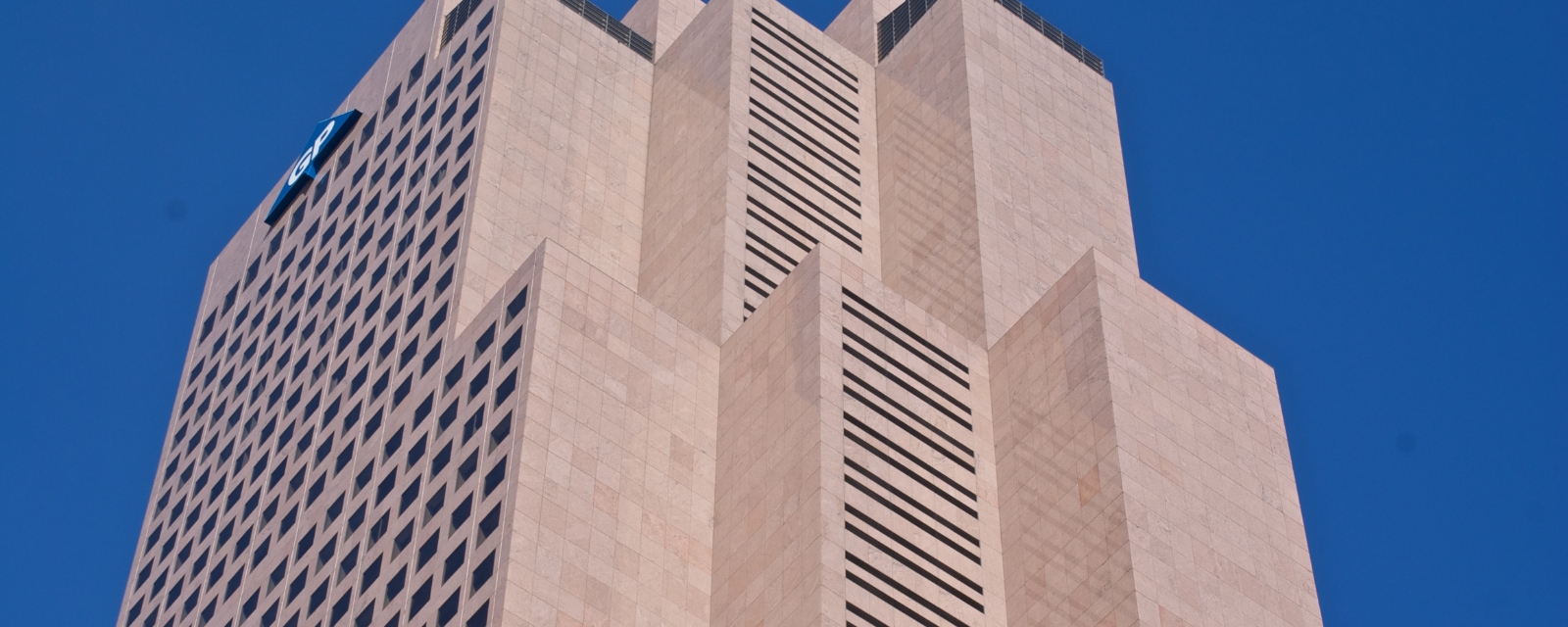
The pink granite tower at Peachtree and Forsyth was supposed to prove that Downtown Atlanta’s empty offices could become something else.
That test is over before construction even started.
Georgia-Pacific has discontinued plans to convert part of its headquarters at 133 Peachtree St. NE into apartments. The company cited higher construction costs and broader market conditions that made a project of this size financially unworkable.
Instead, Georgia-Pacific says it will spend money on critical infrastructure, modernized building systems and employee amenities such as dining, outdoor workspace and workplace technology.
For anyone walking past the building, the practical result is simple. The tower will not get hundreds of new residents, and its street-level transformation is no longer moving forward.
What Downtown just lost
The cancelled plan included approximately 400 apartments on the upper floors of the 697-foot tower.
More than 130 of them, about 30 percent, were supposed to carry rents for households earning between 50 and 80 percent of area median income. Project leader Suzanne Maynard announced that commitment in March.
The original 2024 proposal also included approximately 125,000 square feet of retail, restaurants and entertainment space. By March 2026, the first phase had been reduced to 80,000 square feet.
That reduction now looks like an early sign of the pressure the project was under.
A 35,000-square-foot central plaza was also planned along Peachtree Street, with access to MARTA and the Atlanta Streetcar. More than 2,100 parking spaces were part of the proposal.
Those street-level features mattered even to people who would never rent an apartment upstairs. They would have brought shops, restaurants, public space and residents to a block still organized primarily around office workers.
Georgia-Pacific still owns the tower and an adjacent six-acre block. It has not announced a replacement development plan for that land.
Why this building keeps returning to offices
This corner has already been remade once.
DeGive’s Grand Opera House opened there in 1893. It later became Loew’s Grand Theatre and hosted the Atlanta premiere of “Gone With the Wind” in 1939. The theater closed in 1977, caught fire on Jan. 30, 1978 and was demolished after extensive damage.
Georgia-Pacific Center opened on the site in 1982.
In March 2016, the Invest Atlanta board approved up to $150 million in lease-purchase revenue bonds to renovate 23 floors and keep 2,600 headquarters employees Downtown. The privately placed bonds carried no liability for the city or Invest Atlanta, but the structure was expected to provide approximately $7.2 million in property-tax savings over 10 years.
That renovation went forward as offices. Invest Atlanta still works inside the building at Suite 2300.
The residential proposal needed a different financial structure. Georgia-Pacific planned to seek debt and equity partners and pursue public incentives, but it never disclosed a total budget. No financing package or public incentive agreement was announced before the cancellation.
Four hundred apartments are not the same as 26
This does not mean every Downtown office conversion is impossible.
Leasing is underway at 85 Peachtree, where the historic Bass Dry Goods Building was converted into 26 loft apartments without dedicated parking. Invest Atlanta also says it is continuing the conversion of 2 Peachtree, with at least 200 affordable homes still planned.
But a small historic building and a 51-story corporate tower do not carry the same construction problems or financing needs.
Twenty-six apartments made it to market. Four hundred apartments, including more than 130 affordable units, did not. That difference is where Downtown’s conversion challenge becomes real.
The loss is bigger than 400 apartments. Downtown also lost the residents, affordable homes, storefronts and public activity that were supposed to come with them.
Georgia-Pacific’s decision does not prove office conversions cannot work. It shows that announcing one and financing one are entirely different milestones. If Atlanta wants these projects to become a meaningful part of Downtown’s recovery, the public should know what financial gap it is being asked to fill before another rendering is treated like a result.
If 400 apartments could not work at 133 Peachtree, should Atlanta focus its incentives on smaller conversions or keep trying to make the largest towers work?


