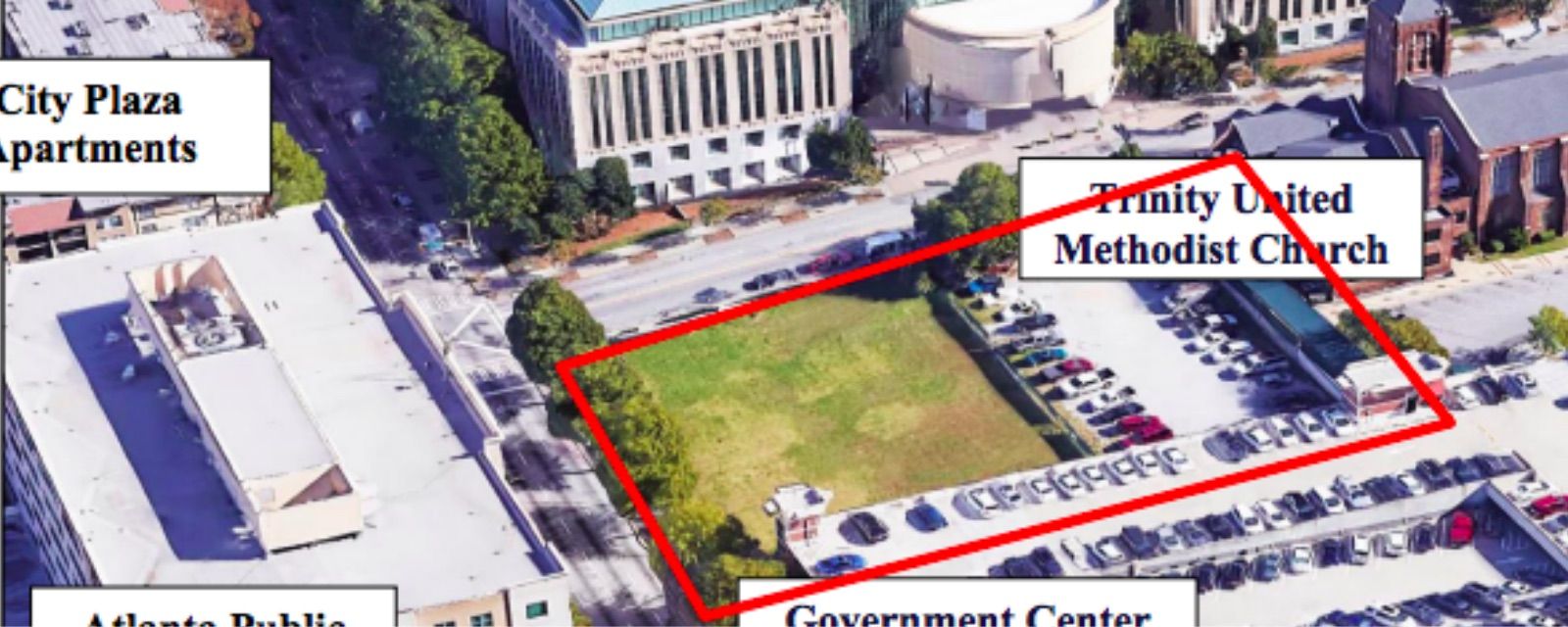
Anyone who parks in the Government Center deck to visit City Hall has walked past the fenced dirt at Trinity Avenue and Shirley Clarke Franklin Boulevard for years. Long enough to stop seeing it.
There is a building on it now.
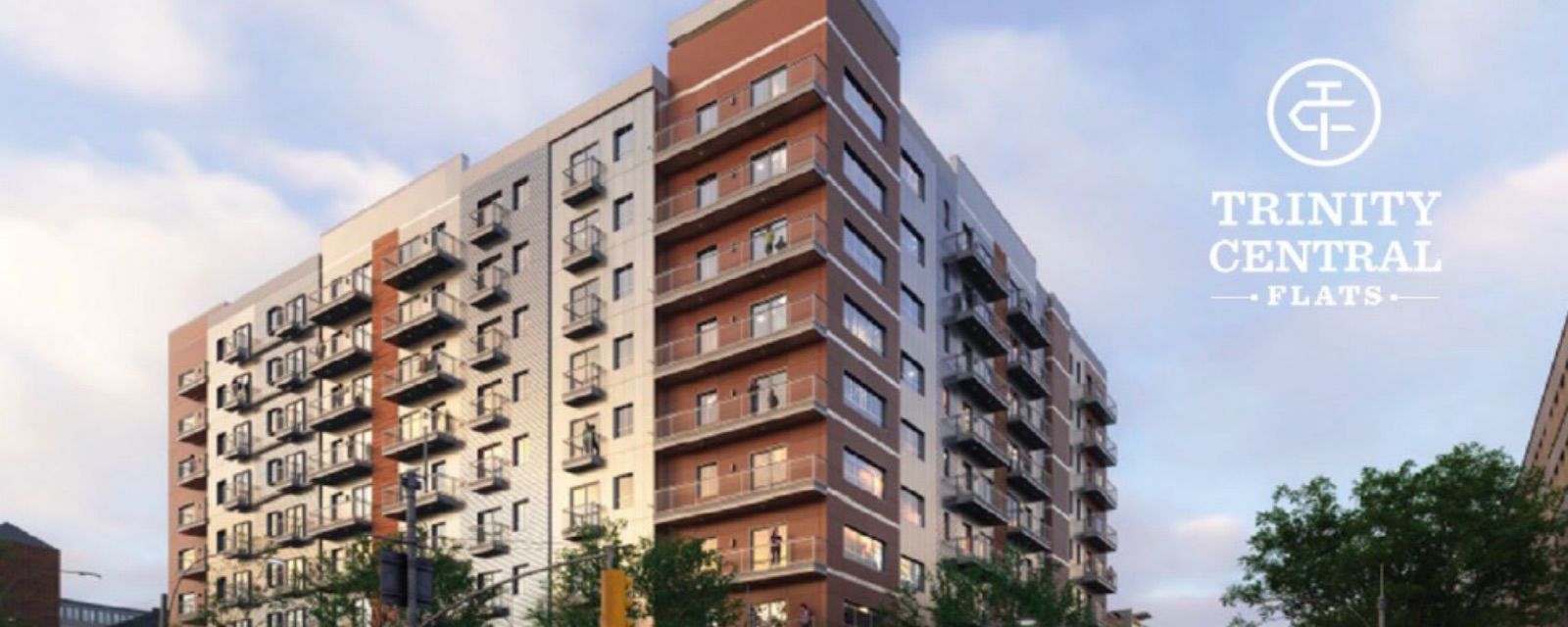
By early September, portions of the exterior had reached two stories. The finished structure will rise nine stories on one end and 10 on the other, topping out at 123 feet in brick and architectural precast.
This is Trinity Central Flats, an affordable housing development rising on 1.3 acres directly across from Atlanta City Hall.
Most of the public documents count 218 apartments. General contractor J.M. Wilkerson describes a 219-unit building, but the developer, Invest Atlanta and the project’s housing-finance partners continue to use 218. Radiant Development Partners says that count includes one non-revenue unit.
All 218 apartments are expected to carry income restrictions for renters earning no more than 80 percent of Area Median Income. The latest financing announcement says 193 will be reserved at either 50 or 60 percent AMI.
What a renter can actually do with this information
Nothing yet, and that is the honest answer.
The contractor lists February 2028 as the completion date. The development team has not opened a leasing portal, published an application date or named the company that will manage the property.
What we can tell you now is how eligibility is expected to work.
Twenty apartments will carry Atlanta Housing HomeFlex vouchers for people experiencing or at risk of homelessness. Residents in those units will pay no more than 30 percent of their income toward rent and will receive supportive services.
The remaining apartments will not require the same voucher, but applicants will still have to meet the income limit assigned to each unit. That means “affordable” does not simply mean the rent looks affordable to you. Household income, household size, the apartment’s AMI tier and the property’s screening requirements will all matter.
Invest Atlanta published a proposed rent schedule in 2024, but those figures were part of the project’s financing plan not a 2028 leasing sheet. The table showed income-capped rents ranging from $893 to $1,924, depending on unit size and AMI level.
What “hundreds of jobs” could actually mean
Radiant says Trinity Central Flats is expected to create “hundreds of construction and permanent jobs.”
That wording needs context.
No public source we found separates temporary construction jobs from permanent positions. There is also no published count of full-time jobs, Atlanta residents hired, wages, apprenticeships or minority- and women-owned contractors participating in the project.
During construction, hundreds of people could touch a project this size over more than two years. That workforce could include concrete and steel crews, equipment operators, masons, carpenters, electricians, plumbers, HVAC installers, roofers, glaziers, drywall crews, painters, landscapers, safety staff, project managers and supervisors.
But those workers would not necessarily be on the site at the same time, and most of those positions end when construction does. “Hundreds of construction jobs” can mean hundreds of individual workers cycling through a project, not hundreds of permanent jobs created at one address.
The permanent positions would look different. A 218-unit building will need property management, leasing and income-certification staff, maintenance technicians, custodial workers and possibly security personnel. The 20 supportive apartments will also require some form of service coordination.
Three retail spaces totaling 6,721 square feet could add store managers, sales or food-service workers, depending on who leases them. No tenants have been announced, so those jobs do not exist yet.
The practical question is not whether the development creates work. It will. The question is how much of that work is permanent, what it pays and whether people who already live in Atlanta get access to it.
Watch for construction hiring information from J.M. Wilkerson and its subcontractors, the names of the three retail tenants and the property-management and supportive-services contracts. Until those details appear, “hundreds of jobs” remains a projection rather than a hiring announcement.
What everyone else gets on this block
Construction will continue into 2028.
At the end, three retail spaces will face Shirley Clarke Franklin Boulevard. The building will connect to the Government Center parking deck through a covered walkway, and a new crosswalk will lead toward City Hall.
The contractor’s current retail figure is 6,721 square feet. That replaces the approximately 7,500 square feet used in earlier plans and in our February 2026 coverage.
Who is actually building this
Radiant Development Partners leads the development team, with Capitol Hill Neighborhood Development Corporation and EQ Housing Advisors as co-owners and co-developers. J.M. Wilkerson is the general contractor, and SSOE is the architect and engineer.
Radiant founder Sharon D. Guest has worked on the development since its earlier iteration under Vecino Group Southeast.
CHNDC is the part of the team most people downtown probably do not know. It is a nonprofit created by leaders from three neighboring churches: Central Presbyterian Church, the Catholic Shrine of the Immaculate Conception and Trinity United Methodist Church.
The organization did not arrive with this apartment project. It helped master-plan the block, coordinated the development of the Government Center parking deck and helped secure land for Hope House, a 70-bed supportive housing facility nearby.
That history matters because Trinity Central Flats is not a conventional developer buying downtown land, constructing apartments and leaving. A nonprofit rooted in three institutions already on these blocks holds a stake in the development partnership.
Another affordable tower is moving next door
At 265 Washington St. SW, Gorman & Company and Trinity United Methodist Church are advancing The Sanctuary, an 83-unit affordable senior housing development.
Current plans call for a 15 or 16-story addition, depending on the source, with apartments restricted for seniors earning between 30 and 80 percent AMI. The historic sanctuary will remain for ministry and community events while the classroom and fellowship wing is replaced.
A March report anticipated a summer 2026 groundbreaking, but that start did not happen. As of early September, the church had removed pews and other interior materials, and its pastor said the development was expected to close by the end of the year. Gorman described the project as nearing construction.
The church is not selling that land either. It plans to lease it to Gorman under a long-term ground lease while retaining ownership.
The delay happened before the building started rising
When the development team was selected in 2021, Trinity Central Flats was presented as an approximately $68 million, eight-story project. By 2024, it had become a 10-story building with a roughly $72 million financing plan and an estimated 2026 completion.
But the financing did not close until December 2025.
Berkadia, which arranged a $23.3 million loan as part of the final capital stack, said the developer encountered “multiple twists and turns” while closing the transaction. It did not identify one specific cause. The finished package combines bonds, loans, federal and state tax-credit equity, city grants, voucher support and deferred developer compensation.
That makes the delay easier to locate, even if it does not fully explain it. Most of the schedule slipped while the design and financing were still being assembled, before construction began in November 2025.
The cost changed too. The project started near $68 million in 2021. Invest Atlanta’s 2024 paperwork put it at approximately $72.1 million. Berkadia described an $88.7 million project when financing closed, while Radiant now lists $130 million in total cost and secured financing. Those figures may measure different parts or stages of the capital stack, but the development team has not published a reconciliation.
J.M. Wilkerson’s current construction contract is approximately $62.1 million, with completion scheduled for February 2028.
So this is not simply a building that started on time and fell behind. It is a project that spent nearly four years reaching financial closing, then entered construction with a later and longer schedule than the public was originally given.
My Take
Since the beginning of the year, we have repeatedly heard Atlantans ask for the same things: housing that is affordable, clean and safe; more access to jobs; and fewer vacant lots sitting behind fences. Trinity Central Flats will not solve all of that, but it is meaningful progress. After watching enough Downtown proposals remain renderings, I find two stories of an actual building more persuasive than another announcement. The city still owns the land, the ground lease supports long-term affordability, and all 218 apartments are now expected to be income-capped. The practical advice is to follow the project without planning a February 2028 move around it just yet. That is the contractor’s completion target, not an announced leasing date. Watch for the leasing portal to open, then ask which AMI level applies to each apartment and whether it is one of the 20 units requiring a HomeFlex voucher. For now, the most encouraging part is simple: a lot that sat empty for years is finally becoming housing people have consistently asked Atlanta to build.
If you work or park around Trinity Avenue, has the crew behind that fence been moving all summer, or did the concrete stop after those first two floors?