Downtown ATL has had the same civic leader for 23 years. Long enough that most people who live, work or own a business there have never needed to learn a second name.
That changes Dec. 1.
Kyle Waide, president and CEO of the Atlanta Community Food Bank, will take over Downtown Atlanta Inc., the organization operating collectively as Central Atlanta Progress and the Atlanta Downtown Improvement District.
Asked about his priorities, Waide named homelessness, safety, cleanliness, connectivity and underused office space. Then he put particular emphasis on housing and residential density, calling it a critical part of Downtown’s long-term success.
The useful thing about that priority is that he does not inherit an empty map.
Downtown already has income-restricted housing. More is accepting residents just beyond the core, and several hundred additional apartments are under construction or nearing completion.
The harder problem is figuring out which properties are actually accepting applications, who qualifies and when the next buildings will open.
What is already operating
Downtown Atlanta Inc. maintains a directory of properties it classifies as income-restricted rentals.
The list includes Bethel Towers, City Lights Senior Housing, Columbia Senior Residences at MLK Village, Columbia Tower at MLK Village, Commons at Imperial Hotel, Cosby Spear Highrise, Edgewood Center, Herndon Square Senior Apartments, Hope House, Maggie Russell Towers, The Melody, O’Hern House, Station 464, Thrive Sweet Auburn, Welcome House and Wheat Street Towers.
Those properties serve different populations. Some are senior housing. Some require income qualification. Some provide supportive housing for people who have experienced homelessness. Others may involve vouchers, referrals or waiting lists.
Being included in an online directory does not mean a property has an apartment available today.
The directory itself shows why the distinction matters. It also places the future Trinity United Methodist Church redevelopment in its “For Rent, Income Restricted” category even though that project has not opened.
For a renter, the directory is a starting point, not a live availability report. You still have to contact the property and ask whether applications or a waitlist are open, what income band applies, whether there is an age restriction and whether a voucher or referral is required.
The most visible recent addition is just west of Downtown. Legacy at Herndon Square has finished construction on 201 apartments, with residents moving in. Of those, 171 are reserved for households earning between 30 and 80 percent of Area Median Income. Some require Atlanta Housing HomeFlex vouchers. Advertised rents begin at $1,100.
The first Herndon Square phase already delivered 97 senior apartments. A third phase under construction is expected to add 178 more rentals in 2027, including 151 income-restricted apartments.
South Downtown also has The Melody, 40 supportive homes on Forsyth Street. Those apartments are not conventional rentals that anyone can apply for directly. Residents enter through the homelessness-response system and receive services with their housing.
That is affordable housing available now, but “available” does not mean the same thing at every address.
What should open next
The nearest deliveries are smaller than the Downtown towers that usually make headlines.
In Sweet Auburn, Firehouse is nearing completion at 26 Hilliard St. NE. The building will contain 10 income-restricted apartments marketed to first responders and people who work Downtown. Rents are expected to be capped at $1,250, including utilities, with completion projected by the end of 2026.
A few blocks away, the first phase of Sweet Auburn Grande is approaching delivery. It includes 109 apartments, with 92 reserved for households earning no more than 30, 50 or 80 percent AMI. The project restores the 1908 Atlanta Life Insurance Building and adds approximately 8,500 square feet of commercial space along the Atlanta Streetcar route.
On Downtown’s northern edge, The Wren at 640 is expected to add 187 apartments reserved for households earning 60 percent AMI or less. The project carries a federal Housing Assistance Payment contract, which means residents receiving that assistance will pay no more than 30 percent of their income toward rent.
Across from Renaissance Park, the first residential building at the Atlanta Civic Center has topped out. As ATL Vibes & Views reported, the building will contain 148 one-bedroom apartments for low-income seniors. Atlanta Housing expects move-ins during the third quarter of 2027.
Together, those four projects represent 437 income-restricted or affordable senior apartments expected between late 2026 and 2027.
The largest Downtown project has no application yet
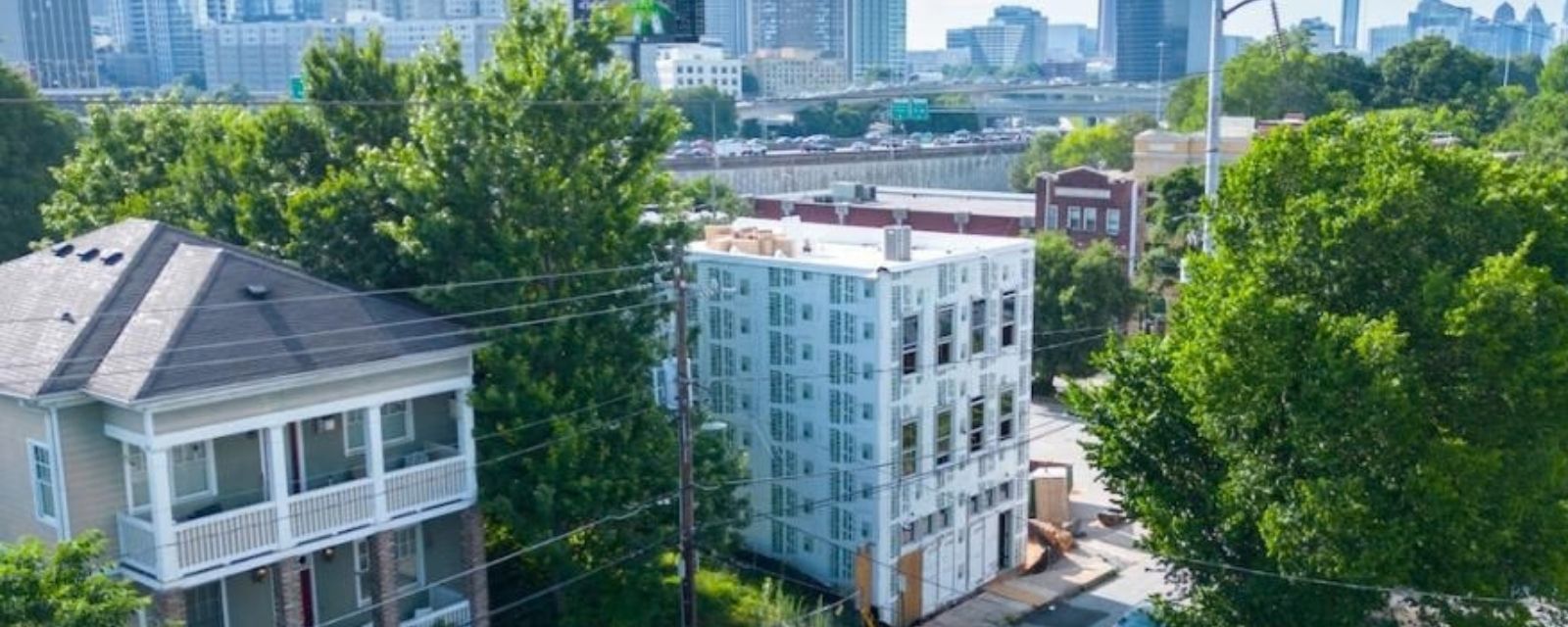
The biggest all-affordable development now rising in the core is Trinity Central Flats, directly across from City Hall.
Our September construction update found portions of the building two stories above ground. Public financing documents count 218 apartments, all capped for renters earning no more than 80 percent AMI. Of those, 193 are reserved at either 50 or 60 percent AMI, and 20 will carry HomeFlex vouchers for people experiencing or at risk of homelessness.
The contractor currently lists February 2028 as the completion date.
There is no leasing portal, application date or publicly named property manager yet. Proposed rents published in 2024 ranged from $893 to $1,924, depending on apartment size and AMI level, but those figures were part of the financing plan rather than a final leasing sheet.
Next door, The Sanctuary is planned as an 83-unit affordable senior development on the Trinity United Methodist Church campus. Apartments are expected to serve seniors earning between 30 and 80 percent AMI.
The project missed an earlier summer 2026 groundbreaking expectation. The church has begun clearing parts of the property, and the development team has described it as nearing construction, but a new opening date has not been announced.
Those two projects could eventually place 301 income-restricted apartments on adjoining blocks across from City Hall.
Lower rent is not the same as income-restricted housing
One other project matters to this conversation, but it belongs in a different category.
At 34 Peachtree St., owner Shaneel Lalani is converting 10 floors of the former One Park Tower into 150 apartments. The projected rents are $1,100 to $1,400 a month, with studios through three-bedroom units planned above the Five Points MARTA station.
Those apartments could give Downtown renters a lower-priced new option when compared with many recently built properties. But no income restrictions, vouchers or legally binding affordability requirements have been announced.
The first 150 apartments are expected in summer 2027. Another 150 are planned in a later phase with no published delivery date.
It is possible for a market-rate apartment to have a relatively attainable rent. That does not make it an affordable-housing unit in the regulatory sense, and the two should not be counted together.
The number Downtown’s new leader inherits
The 2025 State of Downtown report counted 17,753 housing units and projected that total would grow 28 percent over five years. It put Downtown’s residential population at 34,041, up 44 percent since 2010.
Waide will not personally build those homes. Downtown Atlanta Inc. convenes property owners, advocates for investment, supports public-space work and influences how the district presents its needs to City Hall, public agencies and private capital.
That still gives him a practical housing job.
The organization’s own website currently mixes operating properties, specialized supportive housing and an unbuilt project inside the same income-restricted rental directory. A renter cannot see from that page which buildings have vacancies, which waitlists are open or what eligibility rules apply.
That is a solvable problem.
Metro Atlanta has already identified an 89,000-home affordability gap. Downtown will not close it alone. But it can make the housing it has easier to find, help the projects already financed reach opening and report clearly on what each new building actually delivers.
Waide does not need to begin by promising more affordable housing. The pipeline is already visible. The immediate opportunity is to make it usable. Downtown needs one reliable place where a renter can see which income-restricted properties are accepting applications, which waitlists are open, the income limits, age requirements, voucher rules and the dates new buildings expect to begin leasing. Then the construction calendar becomes the second measure: Sweet Auburn Grande, Firehouse and The Wren first, the Civic Center senior building in 2027, and Trinity Central Flats in 2028.
Residential density matters. Knowing who can live in those homes and how they apply matters just as much. If you work or live downtown, which of the five things he named, homelessness, safety, cleanliness, connectivity or empty office space, is the one you actually notice on your walk?
If you work or live downtown, which of the five things he named, homelessness, safety, cleanliness, connectivity or empty office space, is the one you actually notice on your walk?


